
Why Your Tenant Screening Process is Your Most Valuable Asset
Knowing how to screen renters effectively is the key to protecting your rental investment. The difference between a profitable property and a financial headache often comes down to how thoroughly you vet applicants before handing over the keys.
A hasty decision can lead to late payments, property damage, and expensive evictions. Consider that 84% of landlords cite non-payment as their top concern, and a staggering 93.3% of property owners encountered rental application fraud in the past year. A single bad tenant can cost thousands in lost rent and legal fees.
Effective screening isn’t just about being thorough—it’s about being legal, fair, and consistent. You must comply with the federal Fair Housing Act and local regulations, applying the same standards to every applicant to avoid penalties that can reach $20,000 for a single violation.
This guide provides a playbook for making confident, legally compliant decisions. I’m Pablo Negrete, co-owner of Mountain Village Property Management in Bozeman, Montana. We’ve maintained a 98% occupancy rate through rigorous screening, and I’ve learned that a systematic process is the most important skill for protecting rental investments.
The Foundation: Setting Clear, Legal, and Fair Tenant Criteria
Before reviewing applications, you need a solid foundation: clear, legal, and fair criteria. Setting expectations from the start prevents future misunderstandings.

Understanding Your Legal Obligations
The cornerstone of fair housing is the federal Fair Housing Act, which prohibits discrimination based on race, color, national origin, religion, sex, familial status, or disability. In Bozeman, Belgrade, Butte, Livingston, Big Sky, Gallatin Gateway, Three Forks, and Manhattan, Montana, these protections must be applied consistently.
Discrimination can be unintentional. Inconsistent criteria or seemingly innocent questions can lead to violations with penalties up to $20,000. Consistency is a legal imperative; every applicant must be evaluated against the same standards. It’s also vital to stay informed about Montana’s specific regulations, like the Montana Residential Landlord-Tenant Act. For more details, HUD offers official Guidance on Application of the Fair Housing Act to the Screening of Applicants for Rental Housing.
What You Can (and Can’t) Ask
Knowing what to ask is key to a compliant screening process. You need enough information to make an informed decision without straying into discriminatory territory.
Here’s what you can ask for:
- Rental history, previous landlords, and reasons for moving.
- Permission to run credit and background checks.
- Name, address, and date of birth for identity verification.
- Driver’s license, source of income, and expenses for credit reporting.
- Intended move-in date and length of stay.
- Number of occupants (for property capacity, not familial status).
- Pet ownership and smoking habits.
- Prior evictions and parking needs.
Here’s what you cannot legally ask, as these questions touch upon protected classes:
- Social security number (unless for a background check with consent).
- Past disputes with landlords.
- Whether they receive social assistance (source of income, if legal, cannot be a basis for discrimination).
- Age, disability, religion, sexual orientation, place of origin, family status, or gender expression.
- Questions about marital status or number of children.
The golden rule: If a question isn’t directly related to their ability to pay rent or care for the property, avoid it.
Establishing Your Minimum Requirements
With legal boundaries understood, define your ideal tenant with clear, measurable benchmarks. As Kaycee Miller from Rentec Direct notes, “You should think of your tenant screening criteria as a checklist that you go through when reviewing each application.”
Key requirements include:
- Income-to-Rent Ratio: Gross monthly income should be 2.5 to 3 times the monthly rent. For a $1,500 rental, that means an income of $3,750 to $4,500 per month.
- Minimum Credit Score: A score of 680 or higher is a good benchmark, but always analyze the full report for payment patterns and debt levels.
- Rental History Standards: Look for a history of timely payments, no prior evictions, and positive landlord references.
- Employment Stability: Consistent employment for at least 6-12 months indicates a reliable income.
- Applying Criteria Equally: This is the most critical part. Apply these requirements consistently to every single applicant to avoid discrimination claims. A standardized checklist ensures every applicant is evaluated fairly.
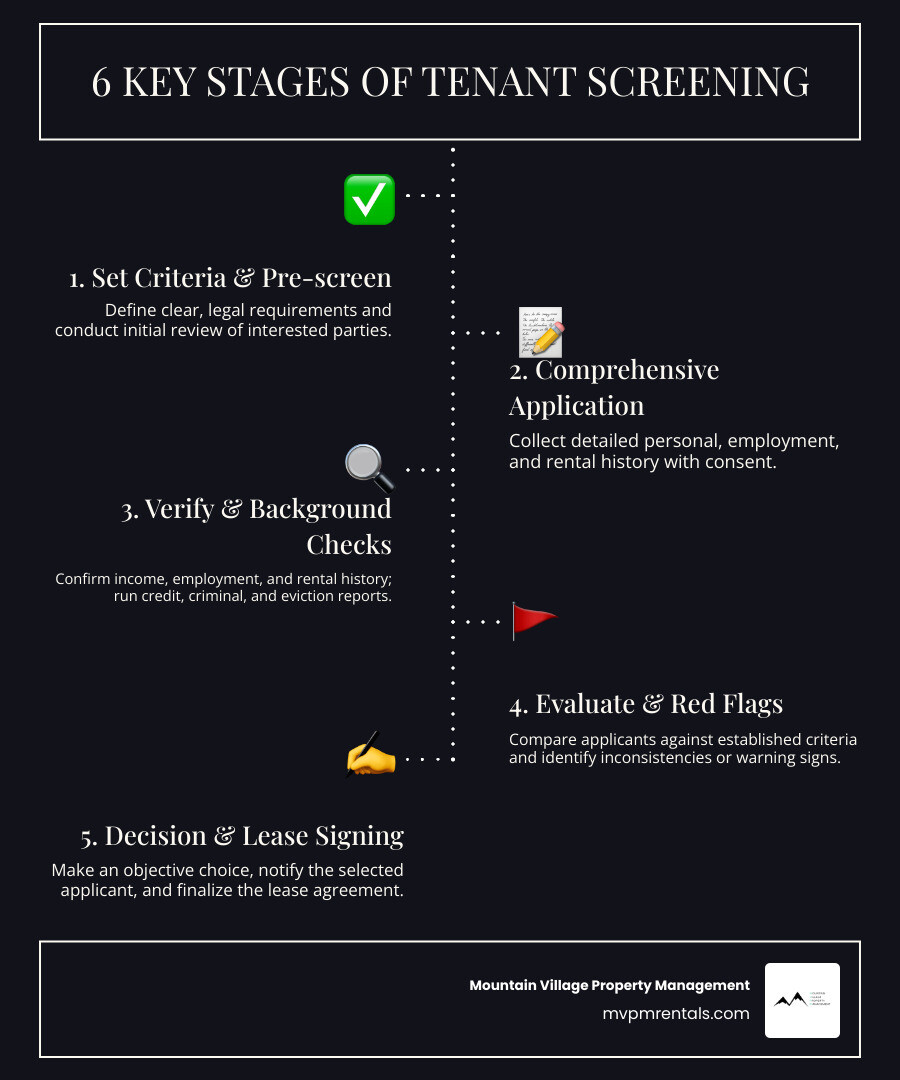
The 5-Step Playbook for How to Screen Renters
With your criteria defined, it’s time to execute your screening plan. This is a systematic approach to finding the perfect match for your property in Bozeman or the surrounding communities.

Step 1: The Comprehensive Rental Application
The rental application is your primary tool for gathering essential information. We recommend pre-screening interested parties with a brief call or questionnaire to ensure they meet basic requirements before they complete a full application. A comprehensive application should collect:
- Personal Information: Full name, contact details, and date of birth.
- Residence History: Current and previous addresses for the past 3-5 years, with landlord contact information.
- Employment Details: Current and past employers, job titles, and gross monthly income.
- References: Personal and professional references.
- Signed Consent for Background Checks: This is non-negotiable. Without written consent, you cannot legally run credit or background checks.
Digital application tools streamline this process, making it easier for applicants to submit information and for you to organize it.
Step 2: Verifying Income and Employment
Always verify the information on the application. With 93.3% of property owners encountering rental application fraud, this step is crucial.
To verify income, request documents like:
- Recent pay stubs (last 1-3 months).
- W-2 forms or tax returns, especially for self-employed applicants.
- Bank statements to corroborate income claims.
With the applicant’s consent, contact their employer to confirm their employment status, job title, length of employment, and salary. This ensures they have a steady income that meets your income-to-rent ratio.
Step 3: Contacting Previous Landlords and References
This step offers a glimpse into a tenant’s real-world behavior. Previous landlords provide the most objective perspective.
When contacting them, ask targeted questions:
- Payment History: Was rent paid on time?
- Property Care: Were there any damages beyond normal wear and tear?
- Lease Violations: Did they adhere to all lease terms (pets, noise, etc.)?
- Notice Given: Did they provide proper notice before moving?
- Would you rent to them again? This simple question is incredibly telling.
Always verify the landlord’s identity to ensure the reference is legitimate. A previous landlord has no incentive to be dishonest, unlike a current landlord who may want a problematic tenant to leave.
Step 4: Running Credit and Background Checks
These checks provide objective data on an applicant’s financial responsibility. Always obtain written consent first.
Using a reputable screening service, look for:
- Credit Report Analysis: Look beyond the score. Analyze payment history, overall debt levels, and any collections or bankruptcies. Debts owed to previous landlords or utility companies are major red flags.
- Eviction History: Check for any past eviction filings. A prior eviction is a serious concern, indicating a failure to meet lease obligations.
- Criminal Record Checks: When evaluating criminal history, adhere strictly to Fair Housing guidelines. This means considering the nature, severity, and recency of any offense rather than using blanket exclusions. Focus on offenses that impact the safety of other residents or the property. For more information, refer to The Fair Housing Act.
Step 5: The In-Person Meeting
An in-person meeting offers invaluable qualitative insights. This is your chance to observe their demeanor and ask clarifying questions.
During a property showing, pay attention to:
- Punctuality and Professionalism: Do they arrive on time and act respectfully?
- Communication Style: Is communication clear and articulate?
- Interest in the Property: Do they ask thoughtful questions about the home and community?
- Overall Demeanor: An in-person meeting helps you gauge their character and how they might fit into the neighborhood.
This step is crucial for choosing the best tenant—someone who is not just financially qualified but also responsible and respectful.
Analyzing the Results: Red Flags and Making Your Decision
After collecting and verifying all information, it’s time to analyze the results using your objective criteria.
| Criteria | Applicant A (Score) | Applicant B (Score) | Applicant C (Score) |
|---|---|---|---|
| Income | Meets 3x (5) | Meets 2.5x (4) | Below 2.5x (1) |
| Credit Score | 720 (5) | 660 (3) | 580 (1) |
| Rental History | Excellent (5) | Good (4) | Evictions (0) |
| References | Strong (5) | Positive (4) | Weak/Unreachable (1) |
| Total Score | 20 | 15 | 3 |
Common Red Flags to Watch For
Be vigilant for these common warning signs:
- Inconsistent Information: Discrepancies between the application and verification, which may signal an attempt to hide something.
- Gaps in Rental or Employment History: Unexplained long gaps can indicate instability.
- Reluctance to Provide Information: Evasiveness or resistance to providing documents is a major red flag.
- Negative Landlord References: A bad reference concerning property damage or lease violations is a serious concern.
- History of Evictions or Late Payments: This directly indicates potential future rent collection problems.
- High Debt Load: Significant outstanding debts can indicate financial strain that might impact their ability to pay rent.
- Pushiness or Demanding Behavior: An aggressive attitude can be a preview of a difficult tenant relationship.
- Requests to Pay in Cash Only: This may be an attempt to avoid a paper trail.
How to Fairly Compare Multiple Qualified Applicants
When you have several great applicants, choose without bias:
- Use a Scoring System: Use a weighted scoring system based on your criteria (income, credit, etc.) to create an objective, numerical comparison, as shown in the table above.
- First-Come, First-Served for Qualified Applicants: To eliminate bias, some landlords accept the first applicant who meets all criteria and completes the screening process.
- Document Your Decision-Making Process: Always document why you selected one tenant and declined others. This record is invaluable for defending against discrimination claims.
Communicating Your Decision Professionally
Prompt and professional communication is vital.
- Notifying the Chosen Applicant: Contact your chosen tenant to share the good news and outline the next steps (lease signing, deposit, etc.). For questions, Mountain Village Property Management is available at 406-602-2018 or admin@mvpmrentals.com.
- Sending Adverse Action Notices to Rejected Applicants: If you deny an applicant based on a credit or background check, you are legally required by the Fair Credit Reporting Act (FCRA) to send an “adverse action notice.” This letter must state the reason for denial, provide the reporting agency’s contact information, and inform them of their right to dispute the report. Otherwise, a polite denial is a professional courtesy.
Frequently Asked Questions about Tenant Screening
Here are answers to some of the most common questions we hear about how to screen renters.
What is a good credit score for a renter?
While there’s no magic number, a credit score of 680 or higher is a good benchmark. The average U.S. renter’s score was 638 in 2020, so you will see a range. The score is just one piece of the puzzle. Always look at the entire credit report to understand the applicant’s financial habits. Look for patterns of responsibility, like on-time payments, rather than focusing on a single number. A lower score with a stable job and great rental history can be a better risk than a high score with no rental history.
Can landlords charge a fee for tenant screening in Montana?
Yes, Montana law does not prohibit landlords from charging a reasonable application fee to cover screening costs. However, the fee must be directly related to the actual costs incurred.
It’s essential to:
- Disclose the fee upfront in your listing and application.
- Ensure it covers actual costs for credit/background checks, not for profit.
- Apply it consistently to all applicants to avoid discrimination.
At Mountain Village Property Management, we are transparent about any screening-related costs, ensuring they align with Montana law.
How should I securely store tenant application data?
Securely storing sensitive personal data is a legal and ethical obligation. Follow these guidelines:
- Data Privacy: Only collect necessary information and use it solely for screening.
- Secure Storage: Use encrypted, password-protected digital folders or locked filing cabinets for physical documents. Restrict access to authorized personnel.
- Record Retention: Keep records for accepted tenants for their tenancy plus a legally required period (often one year). For rejected applicants, keep records for the period required to defend against discrimination claims (e.g., 6-12 months).
- Secure Destruction: When records are no longer needed, permanently delete digital files and shred physical documents.
Conclusion: Secure Your Investment with a Flawless Screening Process
Your tenant screening process is your best asset for protecting your investment. A systematic approach to how to screen renters is the foundation of successful property management.
Key takeaways for effective screening:
- Consistency is King: Apply the same objective criteria to every applicant to ensure fairness and avoid discrimination claims.
- Know Your Laws: Stay informed on federal Fair Housing laws and Montana’s landlord-tenant regulations.
- Verify Everything: Never take an application at face value. Always verify income, employment, and rental history.
- Check References: Previous landlords offer invaluable, objective insights.
- Look Beyond the Score: Analyze the full credit report, not just the score.
- Document Everything: Keep meticulous records of your criteria, communications, and decisions.
A consistent, documented, and legal screening process minimizes risk, protects your investment, and leads to positive landlord-tenant relationships.
For expert assistance with Property Management in Bozeman that includes rigorous tenant screening, trust the experts at Mountain Village Property Management. We specialize in maximizing rental income for landlords with a low 8% management fee, $0 setup costs, and high occupancy rates. Let us help you find stellar tenants. Contact us today at 406-602-2018 or admin@mvpmrentals.com.