
Why Thorough Tenant Screening Matters in Montana
Montana tenant screening laws govern how landlords evaluate potential tenants. A thorough process protects your investment by finding tenants who pay rent on time and care for your property, while avoiding the financial risks of late payments, damages, and evictions. In fact, an applicant who has been evicted before is 3 times more likely to be evicted again.
Key Montana Tenant Screening Laws:
- Application Fees: No state-imposed limit, but must be reasonable and non-refundable if disclosed.
- Written Consent: Required for background checks under the federal FCRA.
- Security Deposits: No statutory cap, but a pre-move-in condition statement is required.
- Deposit Returns: Within 10 days (no deductions) or 30 days (with an itemized list).
- Fair Housing: Montana adds marital status, creed, and age to federal protected classes.
- Criminal History: No state ban, but requires a case-by-case assessment for legitimate business reasons.
- Eviction Records: Requires a separate search, as they are not on credit reports.
Compliant screening also protects you legally. Montana law requires specific procedures, from obtaining written consent to sending proper adverse action notices. Errors can lead to discrimination lawsuits or security deposit disputes.
In competitive markets like Bozeman, a solid screening process helps you find reliable tenants quickly while complying with the law. This typically involves verifying income, checking credit, searching eviction records, and contacting previous landlords.
I’m Pablo Negrete, co-owner of Mountain Village Property Management. Managing properties across Southwest Montana, I’ve seen how applying Montana tenant screening laws correctly protects everyone involved. Our 98% occupancy rate is a testament to our thorough, compliant screening process, which I’ll detail in this guide.
The Foundation: Application Fees, Security Deposits, and Consent
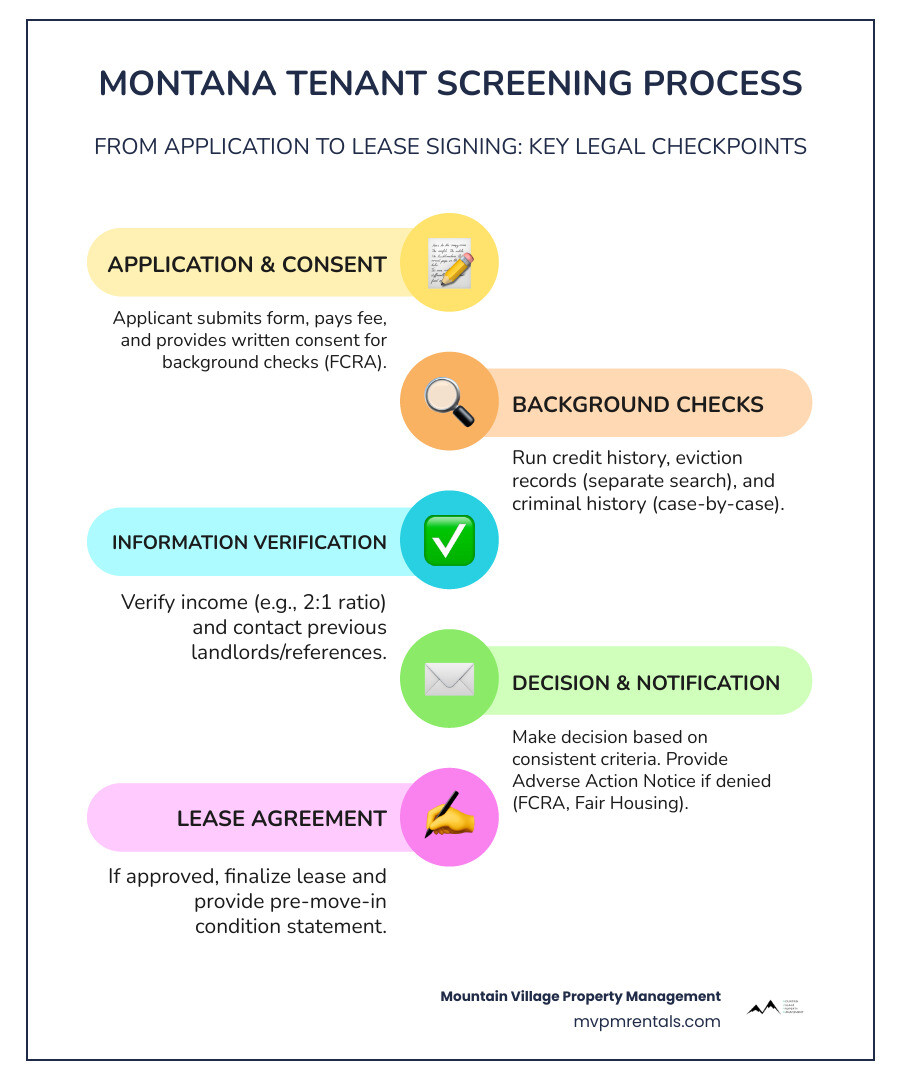
The first steps in screening tenants for properties in Bozeman, Belgrade, and our other service areas involve handling application fees, security deposits, and obtaining consent. These are foundational to a compliant process under Montana tenant screening laws.
Application Fees: Montana has no state-imposed limit on application fees. This allows landlords to charge a reasonable amount to cover screening costs like background checks. It’s vital to disclose in writing if the fee is non-refundable to manage expectations and avoid disputes. These fees should not be called a “deposit” unless they are refundable.
Written Consent: Before running any background check, you must obtain written consent from the applicant. This is a federal requirement under the Fair Credit Reporting Act (FCRA), which protects consumer credit information. Without this consent, a landlord could face significant legal penalties. We ensure our applications have a clear signature line for this purpose.

Security Deposits: Montana law also has no statutory cap on security deposits. However, before collecting a deposit, landlords must provide the tenant with a written pre-move-in condition statement. This document records the property’s condition and is crucial for assessing damages later. Failing to provide this statement can result in losing the right to withhold any part of the deposit for damages. For more details on your rights under federal law, you can refer to the Summary of Your Rights Under the FCRA.
Security Deposit Timelines and Deductions
Montana law specifies timelines for returning security deposits after a tenancy ends. These rules ensure fairness for both landlords and tenants.
According to Montana’s security deposit law (MCA § 70-25-202), the deposit must be returned within:
- 10 days if there are no deductions for damages, cleaning, or unpaid rent.
- 30 days if deductions are made. In this case, you must provide the remaining balance along with an itemized written list explaining each charge.
Valid reasons for deductions include unpaid rent, damages beyond normal wear and tear, and necessary cleaning charges. Failing to provide the itemized list within the 30-day window can forfeit your right to withhold any of the deposit. A thorough move-out inspection, compared against the pre-move-in condition statement, is the best way to document deductions and prevent disputes.
Understanding Montana Tenant Screening Laws and Fair Housing
Understanding federal and state fair housing regulations is a core part of navigating Montana tenant screening laws. These laws ensure everyone has equal access to housing, free from discrimination.
The Federal Fair Housing Act prohibits discrimination based on race, color, religion, sex, national origin, familial status, and disability. Montana’s Human Rights Act adds further protections for marital status, creed, and age. Our screening practices must avoid discrimination against any of these protected groups.

To comply, we apply consistent screening criteria to every applicant. If we set an income-to-rent ratio or check credit history for one person, we must do so for everyone. This consistency is crucial for avoiding discrimination claims.
It’s also important to avoid policies with a “disparate impact.” A seemingly neutral policy can be discriminatory if it disproportionately affects a protected class without a legitimate business justification. For example, a blanket ban on any criminal history could have a disparate impact on certain groups.
Penalties for fair housing violations are severe, including heavy fines and legal fees that can damage a landlord’s finances and reputation. We ensure our screening processes are fair, objective, and fully compliant.
Key Aspects of Montana Tenant Screening Laws
Fair and legal screening requires careful attention to protected classes at both the federal and state levels. Adhering to these guidelines fosters an inclusive rental market in communities like Bozeman and Livingston.
Here is a list of protected classes to consider:
- Federal: Race, color, religion, sex (including sexual orientation and gender identity), national origin, familial status, and disability.
- Montana-Specific (MCA § 49-2-305): Marital status, creed, and age.
Our approach is to apply screening criteria uniformly to every applicant, avoiding “blanket policies” that might inadvertently discriminate. For example, instead of a blanket refusal, we assess each application individually based on objective criteria. Documenting the non-discriminatory reasons for any denial is a critical best practice that serves as a defense against potential claims.
For more information, explore the resources at Montana Fair Housing.
Navigating Montana Tenant Screening Laws for Criminal History
While Montana has no state law prohibiting landlords from considering criminal histories, federal fair housing guidance requires a careful and consistent approach. You cannot use criminal records indiscriminately.
Any denial based on criminal history must be tied to a “legitimate business concern,” meaning the offense is relevant to the safety of the property or other tenants. Instead of blanket policies (e.g., “no felons”), HUD recommends a case-by-case assessment that considers:
- The nature and severity of the crime.
- How long ago the conviction occurred.
- Evidence of rehabilitation.
It is also crucial to distinguish between arrests and convictions. Denying an applicant based solely on an arrest record is not recommended, as an arrest is not proof of guilt. Following the HUD guidance on criminal history helps ensure your screening process is fair and compliant.
Building Your Screening Report: What to Include
A comprehensive screening report is key to finding reliable tenants in Southwest Montana. It pieces together a full picture of an applicant’s financial and rental history. Here’s what we include:
1. Credit History: More than just a score, a credit report reveals financial habits. We analyze:
- Bankruptcies: Recent filings can signal financial instability.
- Liens and Judgments: These show unpaid debts or past legal issues.
- Payment History: A consistent record of on-time payments is a positive sign.
2. Eviction History: This is a critical check that requires a separate search, as eviction records are not on standard credit reports. We look for:
- Forcible Entry and Detainer: A legal action to remove a tenant, which is a major red flag.
- Judgment for Possession: A court ruling in a prior landlord’s favor for an eviction.
- Money Judgments: Awards for unpaid rent or damages. These may appear on a credit report, but the eviction filing itself will not.
3. Rental History Verification: With the applicant’s consent, we contact previous landlords to ask about:
- On-time rent payments
- Lease compliance
- Property care
- Neighbor complaints
- Proper move-out notice
4. Employment and Income Verification: We verify that the applicant can afford the rent by contacting employers and reviewing proof of income (pay stubs, tax returns). A common benchmark is an income-to-rent ratio of 2:1 or 3:1, meaning their gross monthly income is two to three times the rent.
Analyzing these components helps us make informed decisions and find great tenants for communities like Manhattan and Gallatin Gateway.
The Importance of an Eviction History Check
An eviction history check is one of the most predictive parts of a screening report, yet it’s often overlooked. A standard credit report shows financial responsibility but does not include eviction filings.
This is a critical gap, as the chance of an applicant previously evicted doing it again is 3 times higher than a renter that has never been evicted. This is a significant risk to a property owner’s investment.
Credit bureaus do not report eviction records. An applicant can have a clean credit history but a past eviction that is only findable through a dedicated search. This search reveals case details, outcomes, and any money judgments awarded to the previous landlord.
While a money judgment for unpaid rent or damages might eventually appear on a credit report if the debt is sold to a collection agency, the eviction filing itself will not. For this reason, a separate eviction history check is a non-negotiable step in our process. It protects our clients from lost rent, court costs, and the stress of the eviction process. For more insights, read our guide on Finding Your Perfect Match: Property Management in Bozeman.
Best Practices for a Compliant Screening Process
A compliant and effective screening process under Montana tenant screening laws protects property owners and upholds fair housing principles. We follow several best practices to minimize risk in communities like Bozeman, Three Forks, and Manhattan.
- Establish Written Criteria: We create clear, objective selection criteria (e.g., income requirements, credit standards) and apply them uniformly to all applicants. This ensures consistency and demonstrates non-discriminatory practices.
- “No Blank Space” Policy: We require every field on a rental application to be filled out (using “N/A” where appropriate). This encourages full disclosure and helps identify applicants who may be hiding information.
- Verify All Information: We diligently verify details by contacting employers and previous landlords and cross-referencing with background reports. This is the best defense against false information.
- Provide Adverse Action Notices: If we deny an applicant based on information from a screening report, we provide an adverse action notice. As required by the FCRA, this notice states the reason for the denial and provides the contact information for the reporting agency used.
- Keep Proper Records: We maintain detailed records of all applications, reports, and communications. This documentation is vital for defending against potential discrimination claims.
For detailed guidance, we consult resources like the Montana Legislature Landlord/Tenant Statutes to ensure our practices are current.
Montana vs. Neighboring States: A Quick Comparison
Comparing Montana tenant screening laws to neighboring states highlights its unique approach. Here’s a quick look at how Montana handles application fees and security deposits:
| State | Application Fee Limit | Security Deposit Limit |
|---|---|---|
| Montana | No statutory limit (must be reasonable) | No statutory limit (pre-move-in statement required) |
| Idaho | No specific limit mentioned in this guide | No specific limit mentioned in this guide |
| Wyoming | No specific limit mentioned in this guide | No specific limit mentioned in this guide |
| North Dakota | No specific limit mentioned in this guide | No specific limit mentioned in this guide |
| South Dakota | No specific limit mentioned in this guide | No specific limit mentioned in this guide |
Montana stands out for its lack of statutory limits on these fees, offering landlords in Big Sky and Butte more flexibility. This flexibility is balanced by requirements for transparency, such as disclosing non-refundable fees and providing a pre-move-in condition statement. While other states often impose caps, our focus is on ensuring our practices are compliant and fair within Montana’s legal framework.
Frequently Asked Questions about Montana Tenant Screening
We often get questions from property owners about the specifics of Montana tenant screening laws. Here, we address some of the most common inquiries to help you steer the process with confidence.
Can I charge an application fee in Montana?
Yes. Montana has no statutory limit on application fees, so you can charge a reasonable amount to cover screening costs. You must disclose in writing if the fee is non-refundable. To avoid confusion, do not call a non-refundable fee a “deposit.” Ensure the fee is applied consistently to all applicants.
What is the minimum credit score I can require?
There is no legally mandated minimum credit score in Montana. You can set your own reasonable standard, but you must apply it consistently to all applicants to avoid discrimination claims. While a score of 630 or higher is a common benchmark, it’s best to consider the entire financial picture, including income, employment, and rental history, rather than relying on a single number.
How do I deny an applicant legally?
To legally deny an applicant, you must have a legitimate, non-discriminatory business reason based on your established screening criteria. The crucial step is to provide the applicant with an “adverse action” notice, as required by the FCRA.
This notice must include:
- The specific reason for the denial (e.g., “unsatisfactory credit history,” “income does not meet requirements”).
- The contact information for the screening company that provided the report used in the decision.
- A statement of the applicant’s right to get a free copy of their report and to dispute its accuracy.
Following this procedure is essential for compliance with Montana tenant screening laws and protects you from legal challenges.
Maximize Your Investment with Compliant Screening
Navigating Montana tenant screening laws is an essential part of successful property management. This guide has covered the critical components, from application fees and fair housing laws to the importance of a thorough eviction history check.
The key takeaway is to maintain a consistent, objective, and legally compliant screening process. Establishing written criteria, verifying all information, and providing proper adverse action notices are your best defense against legal risks and the surest way to secure high-quality tenants.
Following these guidelines reduces risk, protects your property, ensures a steady income, and fosters a positive environment in your Bozeman, Belgrade, or Butte rental. It’s not just about filling a vacancy—it’s about making a sound investment decision.
At Mountain Village Property Management, our expertise in Montana tenant screening laws helps us maximize rental income for landlords through our transparent 4.9%–8.9% management fee, no set-up fee (Signature & Summit plans), and high occupancy rates. We handle the complexities of screening and compliance, giving you peace of mind.
If you’re looking for expert, full-service property management in Bozeman and the surrounding areas, we’re here to help. Let us put our experience to work for you.
Contact Us for expert property management services today, or call us at 406-602-2018. You can also email us at admin@mvpmrentals.com.