
Why Property Owners Must Focus on Maximizing Returns
Maximize rental property returns by focusing on three core pillars: increasing rental income through strategic upgrades and pricing, reducing expenses through preventive maintenance and tax optimization, and minimizing vacancy periods through effective marketing and tenant retention. Property owners who implement these strategies typically achieve ROI benchmarks of 8-12%, with some markets supporting even higher returns.
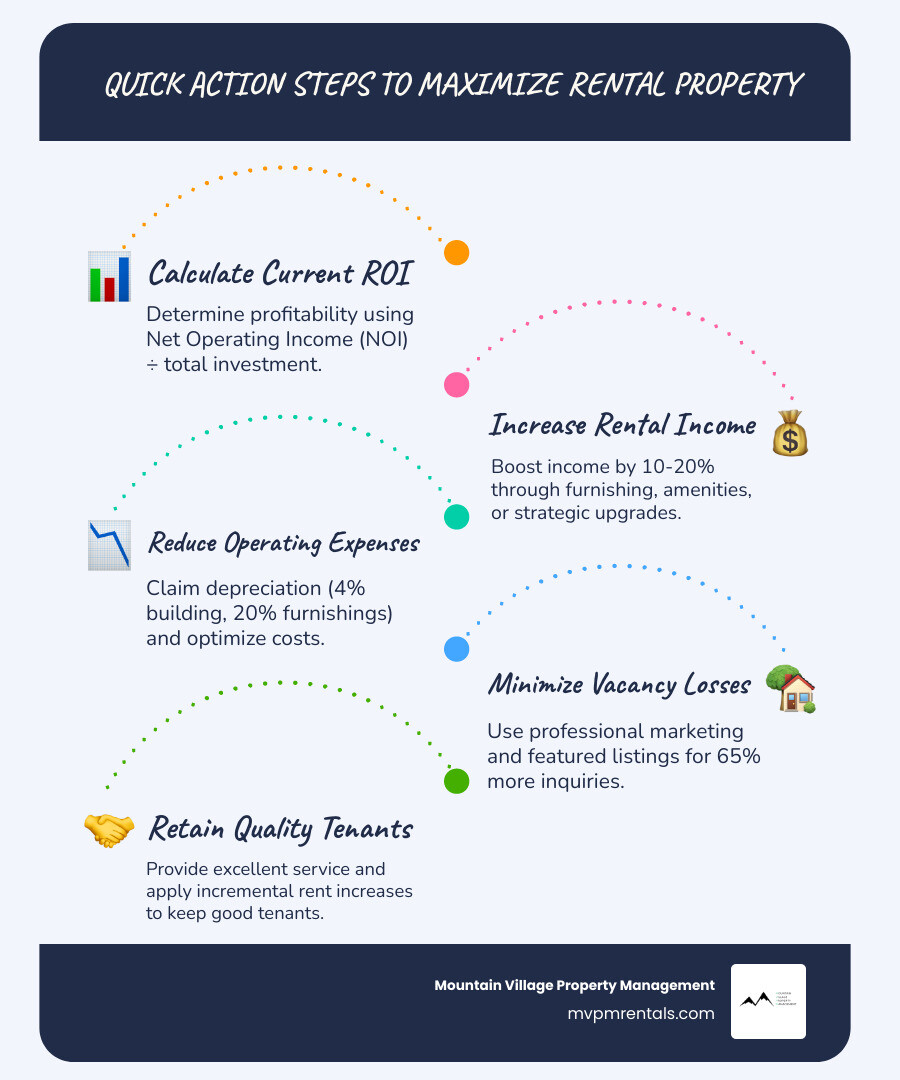
Quick Action Steps to Maximize Your Rental Property:
- Calculate your current ROI using Net Operating Income (NOI) divided by total investment
- Increase income by 10-20% through furnishing, adding amenities, or strategic upgrades
- Reduce expenses by claiming depreciation (4% for buildings, 20% for furnishings)
- Cut vacancy losses with professional marketing and featured listings (65% more inquiries)
- Retain quality tenants through excellent service and incremental rent increases
The difference between a struggling rental property and a thriving investment often comes down to strategy. As one property manager notes, “The last thing you want as an investor is to have an asset in your portfolio that consumes more money than it generates.”
Most landlords focus solely on collecting rent and handling maintenance calls. But that approach leaves significant money on the table. The most successful property owners treat their rentals like businesses—tracking key metrics, implementing proven systems, and making data-driven decisions that compound over time.
In markets like Bozeman, where rental demand remains strong and property values continue to appreciate, the opportunity to build wealth through rental income has never been better. Yet many owners still struggle with inconsistent cash flow, unexpected expenses, and the daily stress of tenant management.
The good news? You don’t need to renovate entire properties or drastically increase rents to see meaningful improvements. Small, strategic changes—like adding smart thermostats, offering flexible lease terms, or simply pricing your property correctly—can add hundreds of dollars to your monthly income while attracting higher-quality tenants who stay longer.
I’m Pablo Negrete, co-owner of Mountain Village Property Management, where we’ve maintained a 98% occupancy rate across properties in Bozeman, Belgrade, Big Sky, and Livingston by implementing these exact strategies to maximize rental property returns for our clients. Through daily hands-on management and continuous market analysis, I’ve seen which tactics deliver real results and which are just noise.
Understanding and Calculating Your Rental Property ROI
Before we dive into strategies, let’s get cozy with some numbers. Understanding your Return on Investment (ROI) is like having a compass for your rental business. It tells you if you’re heading in the right direction and helps us make smart decisions.
ROI measures the profitability of your rental property relative to its overall expenses. It’s crucial because it helps us:
- Identify profitable investments: Before making a purchase, calculating potential ROI helps us determine if a property is “worth our while.”
- Monitor performance: Regularly analyzing ROI allows us to make timely adjustments to improve profitability.
- Make informed decisions: Whether it’s raising rents, undertaking upgrades, or considering refinancing, ROI provides the data needed for strategic choices.
We use a few key metrics to calculate ROI:
- Net Operating Income (NOI): This is your property’s annual income after deducting all operating expenses (property management fees, maintenance, insurance, property taxes), but before accounting for mortgage payments.
- Cash Flow: This is the money left over after all expenses, including mortgage payments, have been paid.
- Capitalization Rate (Cap Rate): This indicates the rate of return on the property based on its income. It’s calculated by dividing NOI by the property’s current market value.
- Simple ROI: This is a straightforward calculation that compares the annual income generated to the total cash invested.
- Cash-on-Cash Return: This metric focuses on the annual cash income earned on the actual cash invested.
Here’s a comparison of the different calculation methods:
| Method | Formula | | Simple Calculation | (Annual Rental Income – Annual Operating Expenses) / Mortgage Value | | Cap Rate | (Net Operating Income / Purchase Price) x 100% | | Cash-on-Cash Return | (Annual Cash Flow / Total Cash Invested) x 100% | | Cap Rate | (Net Operating Income / Purchase Price) x 100% |
| Method | Formula | What it tells you |
|---|---|---|
| Simple ROI | (Annual Rental Income – Annual Operating Expenses) / Total Cash Invested | A quick glance at the overall profitability of your investment relative to the cash you put in. |
| Cap Rate (Capitalization Rate) | (Net Operating Income / Property’s Current Market Value) x 100% | Compares the property’s income to its value, useful for comparing different properties regardless of financing. |
| Cash-on-Cash Return | (Annual Cash Flow / Total Cash Invested) x 100% | Focuses on the cash generated by the property relative to the actual cash you’ve invested (down payment, closing costs, renovations). This is often our favorite for active investors. |
For a full understanding of what constitutes rental income and allowable deductions, we always recommend reviewing official government resources. For our friends in Canada, you might look at information like that found at Rental Income – Canada.ca. For our Montana clients, we’ll focus on relevant US tax guidelines and always suggest consulting with a local tax professional.
Why ROI is the Key to Maximize Rental Property Success
Knowing your ROI isn’t just about crunching numbers; it’s about strategic growth. We use ROI as a critical benchmark to ensure our clients’ investments are not just surviving, but thriving.
- Setting Benchmarks: An ROI of 8-12% is typically considered good for a rental property, though some urban areas might see 4-6% as sound, while others could aim for over 12%. Most real estate investors use a 10% return as a benchmark for a worthwhile property. This gives us a target to aim for when helping you maximize rental property income.
- Informing Strategy: If your ROI is low, we can strategize ways to improve it—whether that’s through rent adjustments, expense reduction, or property improvements. If it’s high, we might consider reinvesting or diversifying your portfolio.
- Investment Scaling: Understanding your ROI allows you to replicate success. Once you know what makes a property profitable, you can apply those lessons to scale your investment portfolio efficiently.
- Portfolio Diversification: For seasoned investors, consistent ROI across multiple properties provides the confidence to diversify into different property types or markets within Montana.
Factors Influencing Your Total Return
Many elements play into your rental property’s ROI, and we pay close attention to each one when advising our clients in Bozeman, Belgrade, Big Sky, and surrounding areas.
- Location, Location, Location: This old adage holds true. A good location isn’t just about curb appeal; it’s about demand. Properties in high-demand areas with low rental vacancy rates—like Bozeman, with its booming job market and university presence—sustain tenant interest and command higher rents. Proximity to amenities, good schools, and public transportation (though less of a factor in some of our more rural areas) are all crucial. We constantly monitor local market conditions to ensure your property is optimally positioned.
- Property Type: Whether you own a condo, a single-family home, or a multi-unit building, each type has its own advantages and disadvantages.
- Condos: Often lower maintenance for owners, popular with students or young professionals. They can have lower turnover rates than single rooms, but typically have HOA fees.
- Houses: Can attract families looking for longer-term stays and more space, potentially leading to lower turnover. However, they usually come with more maintenance responsibilities.
- Furnished vs. Unfurnished: We’ll dive into this more, but furnished properties can often command a 10-20% higher rent, especially for mid-term rentals or corporate housing.
- Vacancy Rates: Nothing eats into your ROI faster than an empty unit. High demand and low vacancy rates, common in our Montana markets, offer more opportunity to real estate investors. We strive for high occupancy rates to keep your income steady.
- Economic Trends: Local and regional economic conditions, including job growth, population influx, and local market supply and demand, all impact rental rates and tenant stability. We use tools like Zillow and our deep local knowledge to stay ahead of these trends, helping you price competitively and attract quality tenants.
High-Impact Strategies to Maximize Rental Property Income
Once we understand your ROI, it’s time to roll up our sleeves and implement strategies to boost your income. We’ve seen these tactics work wonders for our clients across Bozeman, Belgrade, and the wider Gallatin Valley.

Strategic Upgrades to Maximize Rental Property Value
Sometimes, a little refresh can go a long way. Small, cost-effective upgrades can significantly improve your property’s appeal, justify higher rents, and attract high-quality tenants without breaking the bank. As one expert put it, “Many rental units look exactly the same and lack personality, creating an opportunity for differentiation.”
- Kitchen & Bathroom Backsplashes: An updated kitchen or bathroom can completely transform a space. Inexpensive updates to faucets, drawer pulls, and cupboard knobs can make a huge difference. Ensuring counters are clean and unstained, and replacing worn appliances with energy-efficient models, makes a rental feel modern.
- Accent Walls: Adding a stylish accent wall with a neutral, appealing color can create “perceived value” and make a unit feel unique, potentially justifying an extra $50-$100 per month in rent. We often recommend neutral tones like eggshell or beige, as tenants prefer these over stark white.
Smart Home Technology: Integrating smart thermostats and keyless entry systems can appeal to tech-savvy renters, reduce energy consumption, and improve security. These features can often justify a 3-15% rent increase.
Energy Efficiency: Especially important in Montana’s climate, energy-efficient upgrades like LED lighting, well-sealed doors and windows, and improved attic insulation can lower utility costs for tenants and make your property more attractive. If we’re paying for utilities, this also directly reduces our operating costs.
- Outdoor Spaces: Curated outdoor spaces can make a property feel larger and more desirable, enhancing a tenant’s living experience and adding value.
Marketing Tactics to Minimize Vacancies
An empty unit is a money pit! Our goal is to minimize “void periods”—the time your property sits vacant—by attracting quality tenants quickly. We achieve this through a multi-pronged marketing approach.
- Professional Photography & Virtual Tours: High-quality photos are non-negotiable in today’s digital world. We also leverage virtual tours (3D, VR, or live-streamed) to give prospective tenants an immersive experience, helping them visualize themselves in the space and pre-qualifying leads.
- Featured Listings: Did you know that featured listings can get a 65% increase in inquiries and applications? We ensure your property stands out on popular rental platforms, maximizing its visibility to the widest possible pool of qualified renters.
- Digital & Social Media Presence: We create a strong digital presence for your property, sharing listings across multiple platforms and engaging with prospective tenants where they spend their time online.
- Responsive Communication: We make sure to respond to inquiries promptly. This responsiveness is key to securing tenants quickly, as delays can mean losing out to another property.
- Competitive Pricing: We constantly monitor the Bozeman rental market, using hyper-local data to ensure your property is priced optimally to attract tenants while maximizing your income. We include the rental price in all marketing materials to filter out unqualified inquiries from the start.
At Mountain Village Property Management, our proven marketing strategies lead to high occupancy rates, ensuring your investment is consistently generating income. You can learn more about our approach at MVP Rentals – Bozeman Property Management.
Minimizing Expenses and Leveraging Tax Benefits
Maximizing your rental property’s profitability isn’t just about boosting income; it’s also about diligently managing and reducing expenses. Every dollar saved on the expense side directly contributes to your bottom line.
Proactive Expense Management
- Preventive Maintenance: We believe in a proactive approach. Regular inspections and timely small repairs prevent minor issues from escalating into costly disasters. For instance, ensuring good insulation and well-sealed windows in Montana properties can save on heating costs.
- Vendor Negotiation: We establish long-term relationships with reliable, affordable vendors for services like plumbing, electrical, and landscaping. Our bulk buying power and consistent business often lead to better rates for our clients.
- Utility Management: For properties where landlords cover utilities, investing in energy-efficient appliances and systems can significantly reduce ongoing costs. For example, replacing old, inefficient water heaters with purchased models (rather than rented ones, which are common in some other regions) can be a better financial choice in the long run.
- Tenant Retention: High tenant turnover is expensive. It means lost rent during vacancies, cleaning, repairs, and marketing costs. By providing excellent service and fostering positive tenant relationships, we encourage longer tenancies, which is a huge cost saver.
This is where professional property management truly shines. We handle tenant screening, rent collection, maintenance, and tenant relations, ensuring your property stays occupied and well-maintained. This saves you time, stress, and ultimately, money. Find how our services can benefit your property in Bozeman by visiting Property Management Bozeman Montana.
Tax Deductions and Depreciation
Understanding the tax implications of your rental property is crucial for maximizing your net income. While specific tax laws vary by jurisdiction, and we always advise consulting a qualified local tax professional in Montana, here are some general principles that often apply to rental property owners in the United States:
- Depreciation: This allows you to deduct a portion of the property’s value (excluding land) each year, reflecting its “wear and tear.” This non-cash expense can significantly reduce your taxable rental income.
- Interest Deductions: The interest paid on your mortgage for a rental property is typically tax-deductible.
- Property Taxes: Local property taxes are generally deductible expenses.
- Repair and Maintenance Costs: Expenses related to keeping your property in good operating condition, like cleaning, landscaping, and minor repairs, are usually deductible. Capital improvements (like a new roof) are depreciated over time rather than deducted in a single year.
Tax laws are complex and frequently change. We recommend working closely with a tax advisor who specializes in real estate to ensure you’re maximizing all eligible deductions for your Montana rental property.
Legal Responsibilities and Rent Increases
Navigating landlord-tenant laws and rent increase regulations is a critical part of owning rental property. While we don’t have rent control in Montana, understand our local laws to ensure fair practices and avoid legal issues.
- Rent Increases: In Montana, landlords generally have the flexibility to increase rent, but proper notice is always required. Typically, we provide tenants with a written notice of a rent increase well in advance of it taking effect, usually 30 days or more, depending on the lease terms. We consistently monitor market rates to ensure any increases are justifiable and competitive, helping us retain good tenants.
- Tenant Relations: Maintaining positive tenant relations is key. Clear communication, prompt handling of maintenance requests, and respecting tenant rights build trust and encourage longer tenancies. We ensure all our practices comply with Montana’s landlord-tenant laws.
- Lease Agreements: A well-drafted lease agreement is your best friend. It clearly outlines the rights and responsibilities of both landlord and tenant, covering everything from rent payment schedules to pet policies and maintenance expectations. For more general information on proper forms for tenant-landlord interactions, some jurisdictions offer resources like those found at proper forms. In Montana, we ensure our lease agreements are robust and legally sound, protecting your investment.
By adhering to legal requirements and fostering strong tenant relationships, we help you create a stable and profitable rental environment.
Frequently Asked Questions about Maximizing Rental Returns
We hear a lot of great questions from property owners looking to maximize rental property income. Here are some of the most common ones:
What is considered a good ROI for a rental property?
While there’s no “one-size-fits-all” answer, a good ROI for a rental property is generally considered to be in the 8-12% range. For our Bozeman, Belgrade, and Big Sky clients, this is a strong benchmark to aim for. However, “good” can depend on:
- Market Demand: In high-demand areas like Bozeman, where housing is tight, even a slightly lower cap rate might be acceptable due to high appreciation potential and consistent tenant interest.
- Your Investment Goals: Some investors prioritize steady cash flow, while others are focused on long-term appreciation. Your personal goals will influence what you consider a “good” return.
- Urban vs. Rural Returns: Returns can vary significantly. What’s considered excellent in a busy urban center might be different from a more rural or seasonal market. We’ll help you assess what’s realistic for your specific property in our Montana locations.
How can I increase my rent without losing quality tenants?
This is a delicate balance, but it’s absolutely achievable with the right strategy. We focus on:
- Incremental Increases: Instead of large, sudden jumps, we recommend small, regular rent increases (e.g., annually upon lease renewal) that align with market trends. This makes increases easier for tenants to absorb.
- Property Upgrades: As discussed, investing in strategic, cost-effective upgrades (e.g., a fresh coat of paint, updated fixtures, smart home tech) can justify higher rents. Tenants are often willing to pay more for a well-maintained and modern home.
- Excellent Customer Service: Happy tenants are long-term tenants. By being responsive, fair, and proactive with maintenance, we build loyalty. If a tenant feels valued, they are more likely to accept a reasonable rent adjustment.
- Lease Renewal Incentives: Sometimes, a small incentive for renewing a lease—like a fixed rent for two years or a minor property improvement—can be cheaper than the costs associated with tenant turnover.
The key is to always provide value that justifies the rent you’re charging.
Is it better to rent a property furnished or unfurnished?
This depends heavily on your target tenant and market. We’ve seen success with both approaches across our Montana properties:
- Furnished Properties:
- Pros: Can command a 10-20% rent premium, especially for mid-term rentals, corporate housing, or student housing in university towns like Bozeman. They appeal to traveling professionals, digital nomads, and newcomers who need immediate, hassle-free living. Mid-term rentals in Belgrade, for instance, are rapidly gaining popularity for this reason.
- Cons: Higher upfront costs for furniture, increased wear and tear, and potentially higher turnover if targeting short-term stays. Inventory management for furniture can also be a consideration.
- Unfurnished Properties:
- Pros: Attracts long-term tenants who want to personalize their space, often leading to lower turnover and less management of contents.
- Cons: Typically lower rental rates.
We often recommend considering furnished options in areas with a strong transient population, such as seasonal workers near Big Sky, or students in Bozeman. For more information on tenant services and how we can help you make this decision, explore our More info about tenant services page.
Conclusion
Maximize rental property returns is not just about luck; it’s about applying proven strategies with precision and local expertise. From calculating your ROI to implementing high-impact upgrades and smart marketing, every step contributes to a more profitable and less stressful investment journey.
At Mountain Village Property Management, we pride ourselves on helping property owners in Bozeman, Belgrade, Butte, Livingston, Big Sky, Gallatin Gateway, Three Forks, and Manhattan achieve their financial goals. Our hassle-free, full-service property management approach, combined with a transparent 4.9%–8.9% management fee and no set-up fee (Signature & Summit plans), means you keep more of your hard-earned rental income. We consistently maintain high occupancy rates, turning your property into a well-oiled money-making machine.
Ready to see how we can help you maximize rental property income and achieve financial freedom? Let’s chat!
Email us at admin@mvpmrentals.com or visit our website to learn more.