
Stop Overpaying the IRS: What Every Bozeman Landlord Needs to Know
Yes, you can deduct property management fees from rental income — and it’s one of the simplest, most overlooked tax breaks available to rental property owners.
Here’s the quick answer:
| Question | Answer |
|---|---|
| Are property management fees tax deductible? | Yes — they are classified as ordinary and necessary business expenses |
| Where do you report them? | Schedule E (Form 1040) under rental expenses |
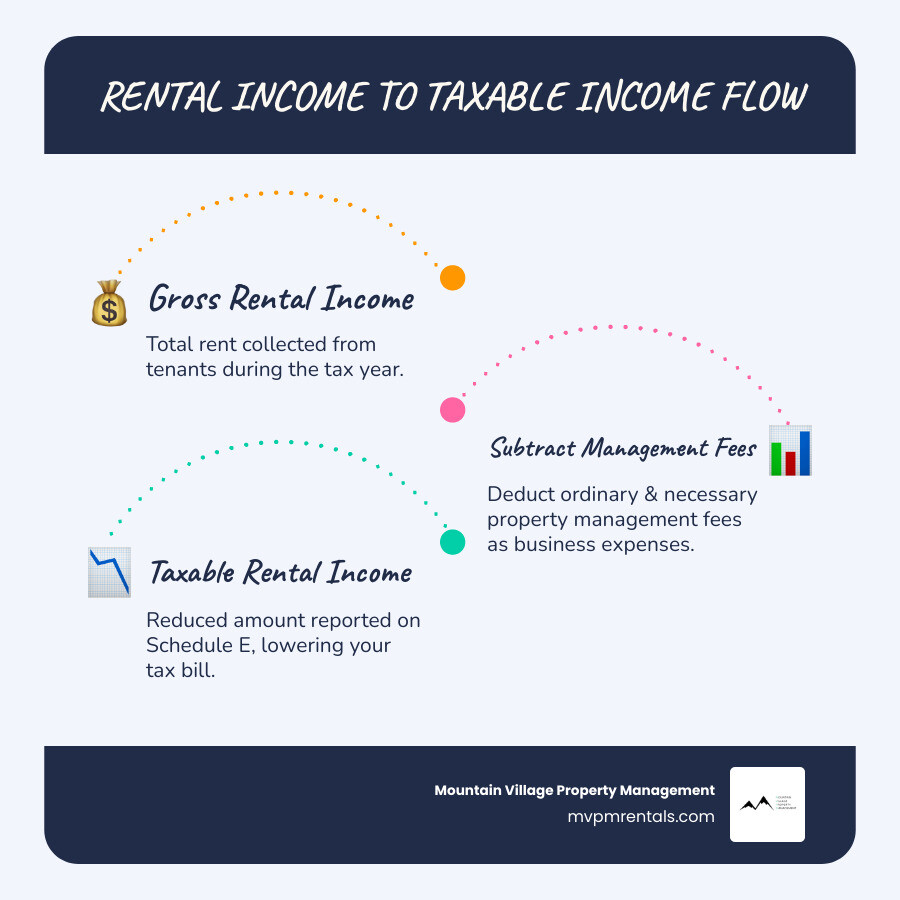
| What’s the tax impact? | Fees are subtracted from gross rental income, directly reducing your taxable income |
| Does it apply to professional managers only? | No — fees paid to any individual or company for managing your rental qualify |
| Can you deduct your own labor if you self-manage? | No — only actual payments to third parties are deductible |
Yet according to a 2021 industry survey, roughly 62% of rental property owners miss this deduction entirely — leaving hundreds or even thousands of dollars on the table every year.
If you’re paying a property manager 8%–12% of monthly rent (the industry standard), that’s real money coming off your tax bill. For example, a property earning $30,000 per year with $1,188 in management fees reduces your taxable rental income to just $28,812 — before any other deductions.
This guide walks you through exactly how to claim it, what counts, what doesn’t, and how to avoid the mistakes that trigger IRS scrutiny.
I’m Pablo Negrete, co-owner of Mountain Village Property Management in Bozeman, Montana — and through managing single-family homes and multi-unit rentals across Southwest Montana, I’ve seen how understanding whether you can deduct property management fees from rental income directly impacts an owner’s bottom line. In this guide, I’ll break it all down so you can stop leaving money on the table.
Can You Deduct Property Management Fees from Rental Income?
When we talk to owners in Belgrade or Big Sky, the first question is usually: “Is this fee just another cost of doing business?” The answer is a resounding yes, but with a silver lining. The IRS classifies property management fees as an ordinary and necessary expense for managing, conserving, or maintaining property held for the production of income.
In plain English, “ordinary” means it is common and accepted in the rental business. “Necessary” means it is helpful and appropriate for your rental activity. Since hiring a pro to handle 2:00 AM furnace failures in a Three Forks winter is both common and helpful, the IRS allows you to subtract these costs from your gross receipts.
According to the IRS classification of deductible fees, these are fully deductible in the year you pay them. For the 2025 tax year, this remains a cornerstone of rental property accounting. Whether you own a condo in Gallatin Gateway or a multi-family unit in Butte, as long as the property is available for rent, those management checks you write are tax-savers.

What Qualifies as a Deductible Property Management Fee?
It isn’t just the monthly “percentage of rent” fee that counts. Most Property Management agreements involve several types of charges, and almost all of them are deductible. These include:
- Marketing and Leasing: Costs for advertising the property and screening applicants are considered ordinary and necessary.
- Tenant Placement: The flat fees often charged to find and vet a new tenant.
- Rent Collection and Financial Reporting: The administrative work of handling the books.
- Eviction Legal Fees: If things go south, the IRS allows deductions for legal fees paid for work related to your rental activity, including evictions.
- Inspections: Routine walk-throughs to ensure your Livingston investment is being respected.
Why You Can’t Deduct Your Own Labor When You Self-Manage
This is the “gotcha” for many DIY landlords. We often hear owners say, “I spent 20 hours painting and managing the lease this month; can I deduct my time at $50 an hour?”
Unfortunately, the IRS is very clear in Publication 527: you cannot deduct the value of your own “sweat equity” or labor. You can only deduct actual out-of-pocket costs paid to third parties. This is a major reason why many choose Bozeman Montana Property Management. When you pay us our low 8% fee, that entire amount becomes a tax deduction. When you do the work yourself, your time is “free” in the eyes of the IRS—meaning you get no tax break for the hours you lose.
How to Report and Claim Management Fees on Your Taxes
Claiming your deduction isn’t a dark art, but it does require the right paperwork. Most landlords use cash basis accounting, which means you report income when you actually receive it and deduct expenses in the year you actually pay them.
To claim these fees, you will use Schedule E (Supplemental Income and Loss). This is the standard form for reporting income from real estate rentals. You’ll find a specific line—usually Line 11—dedicated to “Management fees.” You simply total up everything you paid your manager during the calendar year and enter it there.
Essential Documentation for Deducting Property Management Fees
If you’re ever audited, “I think I paid them about $2,000” won’t fly. You need a paper trail. As a leading Rental Agency in Bozeman Montana, we provide our owners with detailed monthly statements and a year-end summary to make this effortless.
To stay compliant with recordkeeping per Publication 583, you should keep:
- Form 1099-NEC: If you pay an individual (who isn’t incorporated) more than $600 in a year for management, you are generally required to issue them this form.
- Monthly Statements: These show the gross rent collected and the fees withheld.
- Invoices and Receipts: For any one-off fees like lease renewal or inspection charges.
- Bank Records: To prove the flow of funds.
Distinguishing Fees from Repairs and Capital Improvements
It’s vital to distinguish between a management fee and a repair or improvement that the manager coordinated.
- Repairs: These keep your property in good working condition (like fixing a leaky sink in Manhattan, MT). These are fully deductible in the year they occur.
- Capital Improvements: These add value or prolong the life of the property (like a new roof or a full HVAC replacement). These cannot be fully deducted at once. Instead, they must be depreciated over a useful life of 27.5 years for residential property.
The management fee itself—the 8% or 10% you pay for the service—is always an operating expense and never needs to be depreciated.
Understanding the Limits: Passive Activity and Personal Use Rules
The IRS generally views rental income as “passive,” which comes with some strings attached. If your rental expenses (including management fees) exceed your rental income, you have a loss. Whether you can use that loss to offset your other income (like a W-2 salary) depends on the passive activity limits.
| Status | Deduction Limit | Qualification |
|---|---|---|
| Active Participant | Up to $25,000 of losses | Own 10%+ and make major decisions (like approving tenants or repairs) |
| Passive Investor | $0 (Losses only offset passive income) | Limited involvement in management |
| Real Estate Pro | Unlimited | 750+ hours/year in real estate and it’s your primary job |
For most of our owners in the Gallatin Valley, the Active Participation status is the sweet spot. Even if you hire us to handle the day-to-day, you typically still “actively participate” by approving the lease terms and major repair costs. This allows you to deduct up to $25,000 in rental losses against your ordinary income, provided your Modified Adjusted Gross Income (MAGI) is under $100,000 (the benefit phases out up to $150,000).
The Impact of Personal Use on Your Deductions
Do you have a cabin in Big Sky that you rent out part-time? If you use the property for personal reasons for more than 14 days a year (or 10% of the days it’s rented), the IRS considers it a “dwelling unit used as a home.”
In this case, you must pro-rate your management fees. If it’s rented 80% of the time and you use it 20% of the time, you can only deduct 80% of the management fees. Finding Your Perfect Match: Property Management in Bozeman often involves navigating these tricky vacation-home rules to ensure you don’t over-claim.
Active Participation and Rental Loss Deductions
As mentioned, the $25,000 allowance is a lifesaver for many. To qualify, you don’t need to be the one unclogging toilets. You just need to be involved in “major management decisions.” By working with us, you stay in the driver’s seat for the big stuff while we handle the headaches, keeping your Active Participation status intact.
Maximizing Your Return with Other Deductible Rental Expenses
While you can deduct property management fees from rental income, they are just the tip of the iceberg. To truly maximize your ROI, don’t forget these other common deductions:
- Mileage: For 2025, the standard mileage rate is 70 cents per mile. Keep a log of your drives to the property or the hardware store.
- Mortgage Interest: Usually the largest deduction for financed properties.
- Property Taxes: Fully deductible against your rental income.
- Insurance Premiums: Whether it’s basic fire or specialized landlord liability.
- QBI Deduction: Many landlords qualify for an additional 20% deduction of their qualified business income.
By bundling these with our transparent 4.9%–8.9% management fee, our owners in Belgrade and Three Forks often find that their “taxable” income is significantly lower than the actual cash they put in their pockets.
Frequently Asked Questions about Rental Tax Deductions
Can I deduct property management fees if my property is vacant?
Yes! This is a common point of confusion. As long as the property is “held out for rent”—meaning you are actively trying to find a tenant—the IRS Topic 414 allows you to deduct ordinary business expenses. If you’re paying us to market your Three Forks home while it’s empty, those marketing and management costs are still deductible.
What happens if I fail to report management fees correctly?
The IRS isn’t known for its sense of humor regarding errors. Failing to document or report fees correctly can lead to:
- Audits: Discrepancies between your Schedule E and the 1099s issued by your manager are a red flag.
- Disallowance: Without receipts or contracts, the IRS can simply delete the deduction and send you a bill for the difference.
- Penalties and Interest: These can quickly exceed the original tax savings.
Can I deduct fees paid to a family member for management?
You can, but proceed with caution. The IRS expects a “business relationship.” This means you should pay them a fair market rate (not a massively inflated “gift” in disguise), keep a written contract, and issue them a 1099-NEC if you pay them over $600. If you pay your cousin in Livingston 50% of the rent to “manage” the place, expect the IRS to ask questions.
Conclusion
Maximizing your rental investment in Southwest Montana isn’t just about collecting rent—it’s about keeping as much of that rent as possible. Understanding that you can deduct property management fees from rental income is a critical step toward financial efficiency.
At Mountain Village Property Management, we pride ourselves on being the “hassle-free” choice for owners from Bozeman to Big Sky. Our 4.9%–8.9% management fee is among the lowest in the region, and with no set-up fee (Signature & Summit plans), we make it easy to transition into professional management.
By hiring us, you’re not just buying back your time; you’re creating a clear, documented, and fully deductible business expense that lowers your tax liability. Ready to see how we can help you maximize your ROI?
Contact our Bozeman property management team today for a free consultation. Let’s make sure you’re not a penny over what you owe the IRS this year!