Why Rental Property Repairs and Maintenance Are Critical to Your Investment Success
Rental property repairs and maintenance are the backbone of profitable property ownership. For any rental, from a single-family home in Bozeman to a multi-unit complex, knowing what to fix, when, and who pays is critical to your success.
Quick Answer for Property Owners:
- Landlord Responsibilities: Structure, plumbing, electrical systems, HVAC, major appliances, safety equipment (smoke detectors), and compliance with building codes
- Tenant Responsibilities: Cleanliness, minor upkeep (lightbulbs), reporting issues promptly, and damage they or their guests cause
- Emergency Repairs: Burst pipes, no heat in winter, gas leaks, electrical failures, major flooding – require immediate action
- Non-Emergency Repairs: Dripping faucets, minor appliance issues, cosmetic damage – reasonable timeline for completion
- Tax Treatment: Repairs are fully deductible; capital improvements must be depreciated over 27.5 years (U.S.) or claimed through Capital Cost Allowance (Canada)
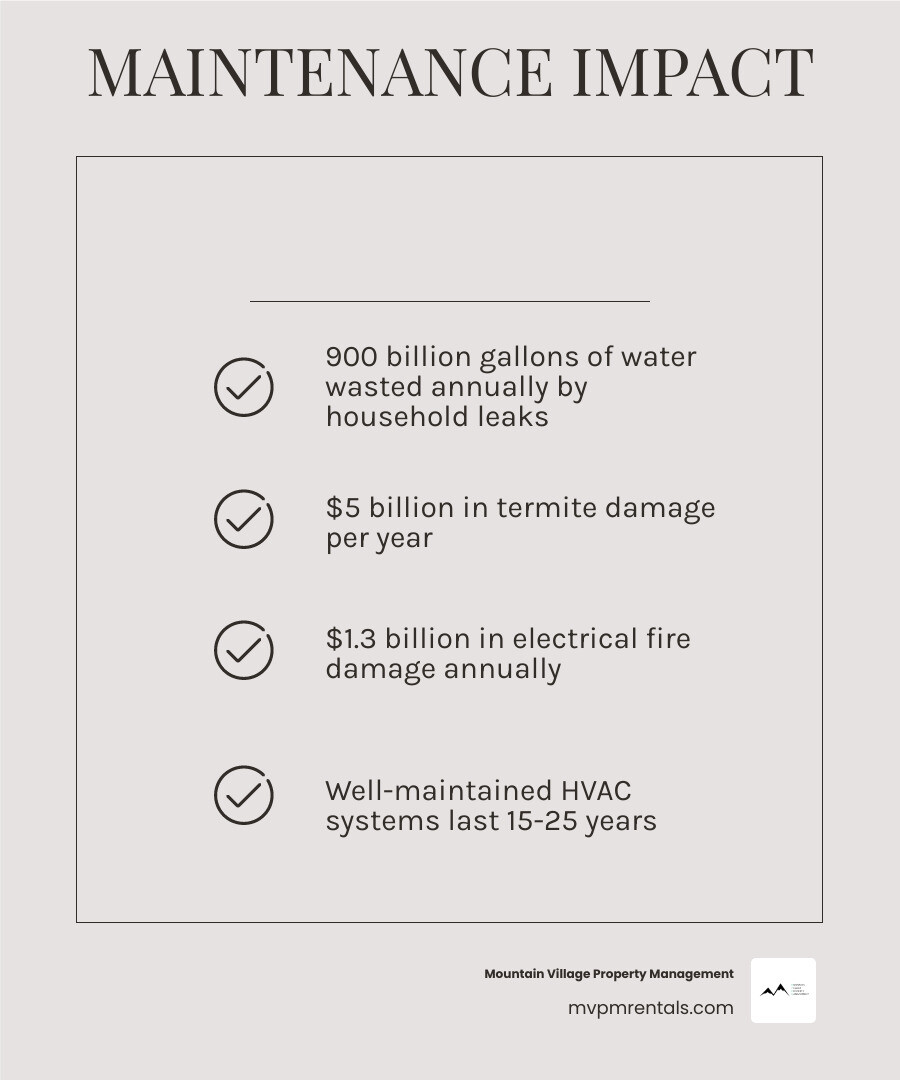
The stakes are high. According to industry data, 900 billion gallons of water are wasted annually by household leaks, $5 billion in damage is caused by termites each year, and home electrical fires result in $1.3 billion in property damage annually. A small leak can become a mold catastrophe, and a neglected HVAC system can fail mid-winter, leaving you with emergency replacement costs of $1,000 to $3,000 for a water heater alone.
Proper maintenance directly impacts your bottom line. It extends the lifespan of major systems (a well-maintained HVAC lasts 15-25 years), prevents costly emergencies, and keeps tenants satisfied, which reduces turnover and vacancy.
This guide covers everything you need to know about rental property maintenance, from legal duties and tax implications to seasonal checklists and handling disputes. You’ll learn how to protect your investment and stay compliant with Montana landlord-tenant laws.
I’m Pablo Negrete, co-owner of Mountain Village Property Management. We manage hundreds of properties across Southwest Montana with a 98% occupancy rate and a 48-hour maintenance response guarantee. My experience has shown that proactive rental property repairs and maintenance are the key to protecting property value and ensuring tenant satisfaction. Let me show you how to get it right.
Landlord vs. Tenant: Who is Responsible for What?

A common point of confusion in rental properties is who handles rental property repairs and maintenance. The key to harmony and legal compliance is understanding the “implied warranty of habitability,” having a solid lease agreement, and maintaining clear communication.
The “implied warranty of habitability” means landlords are legally obligated to provide a safe and livable rental unit. This extends to functioning utilities, structural integrity, and a dwelling free from serious health hazards. Montana’s Residential Landlord-Tenant Act upholds these fundamental rights.
Your lease agreement should clearly outline each party’s responsibilities. What isn’t specified often defaults to the landlord. Clear initial communication prevents future headaches.
Landlord’s Core Responsibilities
As a landlord, your primary responsibility is to ensure the property is safe, habitable, and compliant with all local and state housing codes.
Here’s what generally falls under our purview as landlords:
- Providing a Safe and Habitable Property: This is the overarching principle: the property must be fit for human habitation and free from health or safety dangers.
- Complying with Housing Codes: We must adhere to all applicable building and housing codes relevant to health and safety in Montana.
- Maintaining Structural Components: This includes the foundation, exterior walls, roof, floors, and windows. If the roof is leaking or a wall is crumbling, that’s on us.
- Ensuring Functional Plumbing and Electrical Systems: A working toilet, hot and cold running water, and safe electrical wiring are non-negotiable. Home electrical fires account for 51,000 fires each year and $1.3 billion in damage, so electrical safety is paramount.
- HVAC Maintenance: Heating and air conditioning systems (if provided) must be kept in good working order. No heat in the Montana winter is an emergency! A well-maintained HVAC system can last 15-25 years.
- Smoke and Carbon Monoxide Detectors: We are typically responsible for providing and maintaining these life-saving devices. They should be tested monthly by tenants and replaced every 10 years.
- Common Area Upkeep in Multi-Unit Buildings: In multi-unit properties, we’re responsible for maintaining shared spaces like hallways, stairwells, and parking areas.
- Replacing Major Appliances: If we provide appliances like refrigerators or ovens, we are generally responsible for their repair or replacement due to normal wear and tear.
- Landlord’s legal obligations for safety: The principle of legal obligations for safety is universal. In Montana, we must ensure plumbing, electrical wiring, and the structure of the house are safe, along with functional locks.
Tenant’s Core Responsibilities
Tenants also play a crucial role in maintaining the property, revolving around cleanliness, proper use of appliances, and prompt reporting of issues.
- Keeping the Property Clean and Sanitary: Tenants are expected to maintain a reasonable level of cleanliness to prevent pest infestations and damage.
- Reporting Issues Promptly: This is a critical tenant responsibility. A small leak reported immediately is a simple fix; an ignored leak can cause extensive water damage and mold. Tenants must inform us of any known damage or needed repairs.
- Minor Upkeep: This can include changing lightbulbs, replacing batteries in smoke detectors, and maintaining yard work if specified in the lease.
- Responsibility for Tenant-Caused Damage: If a tenant or their guests cause damage beyond normal wear and tear, they are generally responsible for the repair costs.
- Proper Appliance Use: Tenants should use appliances as intended. For example, knowing what not to put down a garbage disposal can prevent costly plumbing issues.
- Pest Prevention Through Cleanliness: While landlords are often responsible for infestations, tenants have a role in preventing them by keeping the unit clean.
- General tenant maintenance responsibilities: Tenants should keep the property reasonably clean and tidy and ventilate the home regularly to prevent moisture buildup and mold.
The Ultimate Guide to Rental Property Repairs and Maintenance
Effective rental property repairs and maintenance require a clear system for distinguishing between emergencies and routine issues to ensure tenant safety and protect your investment.
| Example | Tenant Action | Landlord Response Time |
|---|---|---|
| Burst pipe, major flooding | Immediately turn off main water valve (if safe), call landlord/emergency line. | Immediate (within hours) |
| No heat in winter (below 55°F) | Call landlord/emergency line. | Immediate (within hours) |
| Major electrical fault (no power, sparks) | Call landlord/emergency line, consider turning off main breaker. | Immediate (within hours) |
| Gas leak | Evacuate, call utility company & landlord/emergency line. | Immediate (within minutes) |
| Sewage backup | Avoid use of plumbing, call landlord/emergency line. | Immediate (within hours) |
| Non-functional refrigerator (landlord-provided) | Call landlord/emergency line. | Immediate (within hours) |
| Dripping faucet | Report to landlord via written request (e.g., email/online portal). | 24-48 hours initial contact, repair within reasonable time (days) |
| Broken cabinet door | Report to landlord via written request. | 24-48 hours initial contact, repair within reasonable time (days) |
| Burnt-out stove element | Report to landlord via written request. | 24-48 hours initial contact, repair within reasonable time (days) |
| Slow drain | Report to landlord via written request. | 24-48 hours initial contact, repair within reasonable time (days) |
| Cracked window pane | Report to landlord via written request. | 24-48 hours initial contact, repair within reasonable time (days/weeks) |
Handling Emergency Rental Property Repairs and Maintenance
An emergency repair is anything that poses an immediate threat to a tenant’s health, safety, or the property’s structural integrity.
Common emergencies include:
- Burst pipe or major flooding: Household leaks waste 900 billion gallons of water annually.
- No heat in winter: In Montana, this is a serious health risk. We recommend keeping the indoor temperature at 55°F+ to prevent frozen pipes.
- Gas leaks: Evacuate and call the gas company immediately, then us.
- Major electrical failures: No power or sparking outlets. Home electrical fires cause $1.3 billion in damage each year.
- Sewage backup: A health hazard that needs immediate attention.
- Defective locks: If a tenant cannot secure their home, it’s a safety emergency.
- Non-functional refrigerator: If provided by us, this is an emergency.
Tenant Procedure for Reporting Emergencies: Tenants should call us immediately. We provide clear emergency contact information, including our emergency line at 406-602-2018.
Landlord’s Obligation for Immediate Action: For emergencies, our response is swift. We must address these issues within hours to mitigate damage and ensure tenant safety, which often means dispatching a technician immediately.
What Tenants Can Do if the Landlord is Unresponsive: If a tenant cannot reach us in a dire emergency, their options depend on state law. Crucially, in Montana, tenants cannot withhold rent for unmade repairs, as this can lead to eviction. The proper course is to document all contact attempts and then reach out to local housing authorities for guidance. Knowing these rights and responsibilities is important for everyone.
Managing Non-Emergency Rental Property Repairs and Maintenance
Non-emergency issues don’t pose an immediate threat but still need attention. Examples include a dripping faucet, a broken cabinet door, or a cracked window pane.
Tenant’s Procedure for Requesting Repairs: For non-emergency rental property repairs and maintenance, we encourage tenants to submit requests in writing via email to admin@mvpmrentals.com or through an online portal. This creates a clear record.
Establishing Reasonable Response Times: We aim to acknowledge non-emergency requests within 24-48 hours and provide a timeline for repair. “Reasonable time” varies based on the repair’s complexity and contractor availability.
Documenting All Communication and Work Orders: Maintaining a detailed record of all requests, responses, and work is a best practice. This documentation helps track costs, verify compliance, resolve disputes, and identify recurring problems.
As your property managers, we handle all these aspects, ensuring every repair is addressed efficiently. More info about our Property Management Services.
The Financial Side: Repairs vs. Capital Improvements

Understanding the difference between a repair and a capital improvement is critical for landlords at tax time. Misclassifying expenses can have significant tax implications. We keep meticulous records to ensure accurate reporting and protect your bottom line.
Tax Implications in the U.S.
For landlords in Montana and across the U.S., the Internal Revenue Service (IRS) has specific guidelines for classifying rental property expenditures.
Defining Repairs (Fully Deductible Current Expenses):
Repairs are expenses that keep your property in good operating condition but do not add to its value or prolong its life. Examples include patching a leaky roof, fixing a broken window, or repairing a faulty appliance. Repairs restore or maintain the property’s current condition. These costs are fully deductible in the year they occur, which can significantly lower taxable income.
Defining Capital Improvements (Depreciated Over Time):
Capital improvements add to the value of your property, prolong its useful life, or adapt it to new uses. According to IRS Publication 523, examples include adding a new room, replacing an entire roof, or a complete kitchen remodel.
For tax purposes, capital improvements are not fully deductible in the year they are incurred. Instead, their cost must be depreciated over their “useful life.” For most residential rental properties in the U.S., this means depreciating the cost over 27.5 years using the General Depreciation System (GDS). You can only deduct a small portion of the cost each year.
IRS Publication 527 guidance is an excellent resource that breaks down how to report rental income and expenses, including depreciation.
Safe Harbor Elections:
The IRS also offers some helpful exceptions:
- Safe Harbor Election for Small Taxpayers: This allows eligible small taxpayers to treat certain improvements as ordinary repairs, simplifying tax reporting.
- Safe Harbor for Routine Maintenance: This allows you to treat routine maintenance activities as fully deductible repairs.
These safe harbors can be a real boon for managing tax obligations. We always recommend consulting with a tax professional to ensure you’re applying these rules correctly.
A Proactive Approach: Your Seasonal Maintenance Checklist
Proactive rental property repairs and maintenance are key to long-term profitability. It’s far cheaper to prevent a problem than to fix one. Regular inspections are essential for spotting small issues before they become costly emergencies.
Montana law allows us to conduct inspections with at least 24 hours of written notice (unless it’s an emergency). This respects tenant privacy while letting us maintain the property. We use inspections to check for maintenance needs, ensure lease compliance, and build positive tenant relationships.
Spring/Summer Checklist
As the snow melts in Bozeman, it’s time for warm-weather maintenance.
- Gutter and Roof Inspection: Check for debris in gutters and downspouts. Inspect the roof for damaged shingles or signs of leaks from winter weather.
- HVAC Servicing: Schedule annual maintenance for air conditioning units. Clean or replace filters and check refrigerant levels to ensure efficiency. This helps extend the system’s 15-25 year average lifespan.
- Window and Screen Checks: Inspect windows for cracks or drafts. Repair or replace torn screens.
- Landscaping and Sprinkler Systems: Prepare sprinkler systems, checking for leaks or broken heads. Trim trees and shrubs away from the house.
- Pest Control Inspection: Spring is when pests become active. Look for signs of insects or rodents and address issues promptly. Termites cause an estimated $5 billion in damage annually.
- Deck and Patio Safety: Inspect decks and railings for loose boards, rot, or structural issues. Make necessary repairs or apply sealant.
Fall/Winter Checklist
Preparing our properties for the Montana winter is essential to prevent burst pipes, furnace failures, and other costly emergencies.
- Furnace and Heating System Inspection: Schedule professional maintenance for heating systems. Clean or replace filters and ensure carbon monoxide detectors are working.
- Plumbing Insulation for Freeze Prevention: Insulate exposed pipes in unheated areas like crawl spaces and garages. Advise tenants to keep the thermostat at 55°F or higher to prevent pipes from freezing.
- Chimney and Fireplace Cleaning: If the property has a fireplace, have the chimney cleaned and inspected annually to prevent fire hazards.
- Checking Seals on Windows and Doors: Inspect weather stripping and caulking around windows and doors. Replace worn seals to prevent drafts and improve energy efficiency.
- Testing Smoke and CO Detectors: Test all smoke and carbon monoxide detectors, replacing batteries as needed. The NFPA recommends testing batteries monthly and replacing detectors every 10 years.
Frequently Asked Questions about Rental Property Maintenance
Navigating the nuances of rental property repairs and maintenance can raise many questions. Here, we address some of the most common inquiries.
Can a tenant withhold rent if repairs are not made?
In Montana, as in most places, a tenant cannot legally withhold rent if repairs are not made. While it may seem logical, doing so can lead to eviction, credit damage, and legal fees.
What should a tenant do if a landlord fails to make necessary repairs?
- Written Communication: The tenant should always start by sending a formal, written request for repairs, detailing the issue and giving a reasonable timeframe to respond.
- Contacting Local Authorities: If the landlord is unresponsive, tenants can contact their local housing authority. These agencies can inspect for code violations and order repairs.
- Legal Action: In extreme cases, tenants may pursue legal action, but this should be done with legal counsel after exhausting direct communication.
For more information on tenant rights, a helpful resource is Nolo’s guide on renters’ rights.
Who is responsible for pest control?
Pest control responsibility can be tricky. Generally, the landlord is responsible for pre-existing infestations or those caused by structural issues, while tenants play a crucial role in prevention.
- Landlord’s Responsibility: We are typically responsible for addressing infestations of termites, rodents, cockroaches, or bed bugs. Termites cause $5 billion in damage annually, and rodents are a problem for an estimated 30% of American homeowners. Cockroaches can spread 33 kinds of bacteria, making immediate action essential.
- Tenant’s Role in Prevention: Tenants are responsible for maintaining cleanliness to prevent attracting pests. This includes proper food storage and regular trash removal. If a pest problem arises from a tenant’s lack of cleanliness, they may be held responsible for extermination costs.
- Importance of Addressing Pest Issues Immediately: Pest issues should be addressed immediately to prevent property damage and health risks.
What happens if the property is temporarily uninhabitable?
Major events like a fire or flood can make a rental temporarily uninhabitable, which complicates a landlord’s obligations.
- Landlord’s Obligations During Major Repairs: If the property becomes uninhabitable due to damage not caused by the tenant, we have several options:
- Provide Alternative Accommodation: We may be obligated to provide or cover the cost of alternative housing for the tenant until repairs are complete.
- Rent Abatement: If parts of the property are unusable or repairs are disruptive, we may need to offer a rent reduction for the affected period.
- Lease Termination: If damage is extensive and repairs will take a long time, both the landlord and tenant may have the right to terminate the lease.
- Role of Landlord Insurance: Landlord insurance is invaluable here. It can cover repair costs, lost rental income, and sometimes even the cost of alternative accommodation for tenants. We always advise clients to have robust landlord insurance.
Simplify Your Maintenance with Expert Management
Effective rental property repairs and maintenance are fundamental to protecting your investment, maximizing profitability, and ensuring tenant satisfaction. From understanding the legal responsibilities of both landlords and tenants to carefully tracking expenses for tax purposes and implementing a proactive seasonal maintenance schedule, there’s a lot to consider.
For landlords in Bozeman, Belgrade, Butte, Livingston, Big Sky, Gallatin Gateway, Three Forks, and Manhattan, Montana, who want to maximize their income without the hassle of late-night repair calls, coordinating contractors, and navigating the complexities of landlord-tenant law, a professional property manager is the solution.
At Mountain Village Property Management, we handle all aspects of rental property repairs and maintenance. Our dedicated team ensures your property is carefully cared for, from routine inspections and preventative maintenance to emergency repairs and tenant communication. We pride ourselves on a transparent 4.9%–8.9% management fee, no set-up fee (Signature & Summit plans), high occupancy rates, and a guaranteed 48-hour maintenance response time, ensuring your property is protected and your tenants are happy.
Let us take the stress out of property ownership. Contact us today at 406-602-2018 or admin@mvpmrentals.com to discuss how we can help you achieve hassle-free success with your rental properties.