
What Is a Rental History Background Check (and Why It Matters)
A rental history background check is one of the most important tools a landlord can use to evaluate a prospective tenant before handing over the keys.
Here’s a quick summary of what it covers:
- Payment history – Did the tenant pay rent on time?
- Lease compliance – Did they follow the rules of their lease?
- Eviction records – Have they ever been formally evicted?
- Property condition – Did they leave previous rentals in good shape?
- Previous addresses – Do their claimed addresses check out?
- Landlord references – What do past landlords actually say about them?
Think of it this way: past behavior is the best predictor of future behavior. A tenant who paid late, damaged a unit, or was evicted before is likely to repeat those patterns. And with the average eviction costing around $11,000 and months of lost time, skipping this step is a gamble most landlords can’t afford.
Choosing the wrong tenant isn’t just a financial hit — it’s stressful, time-consuming, and can seriously disrupt your rental income. That’s why a thorough rental history check belongs at the center of every screening process, not as an afterthought.
I’m Pablo Negrete, co-owner of Mountain Village Property Management (MVPM) in Bozeman, Montana, where I’ve helped property owners across Southwest Montana build reliable tenant relationships through a consistent rental history background check process. In this guide, I’ll walk you through exactly how we do it — and how you can too.
Legal Requirements for Conducting a Rental History Background Check
Before we dive into the “how-to,” we need to talk about the “must-dos.” As property managers operating in Bozeman, Belgrade, and Big Sky, we are bound by both federal and state laws that dictate how we handle a rental history background check.
The most critical step in any screening process is obtaining written consent. You cannot legally pull a credit report or contact previous landlords for sensitive information without a signed authorization from the applicant. This isn’t just a courtesy; it’s a legal shield. In Canada, landlords often look to the Personal Information Protection and Electronic Documents Act (PIPEDA) for guidance on data privacy, and while we are in Montana, the principles of data security and anti-discrimination remain universal.

In Montana, we must also adhere to the Fair Housing Act. This means our screening criteria must be applied consistently to every single applicant. If you require a 650 credit score for one person, you must require it for everyone. Deviating from your established standards can open the door to discrimination claims, which are far more expensive than any bad tenant. For those looking for a hands-off approach that guarantees compliance, our property management services ensure every check is done by the book.
Understanding Tenant Privacy Rights
Tenants have a right to know what information is being collected and how it will be used. Under privacy guidelines, you should only collect information that is directly relevant to the tenancy. For example, while you need to verify income, you don’t necessarily need to know a tenant’s medical history or specific personal details that don’t impact their ability to pay rent or care for the property.
According to the MyCRC background check guide, renters are increasingly proactive about their data. They have the right to access the reports you pull and correct any inaccuracies. If you deny an applicant based on a rental history background check, you are often required to provide an “adverse action” notice explaining why, especially if the decision was based on a credit report.
Documenting the Screening Process
Consistency is your best friend. We recommend keeping a “screening file” for every applicant. This file should include:
- The signed application and consent form.
- The results of the rental history background check.
- Notes from reference calls.
- A copy of the written criteria used to make the decision.
By documenting everything, you can prove that your selection process was objective and fair. If you’re a renter looking for a fair shake, you can start by filling out our renter contact form to see our available listings.
Step-by-Step Best Practices for Verifying Tenant History
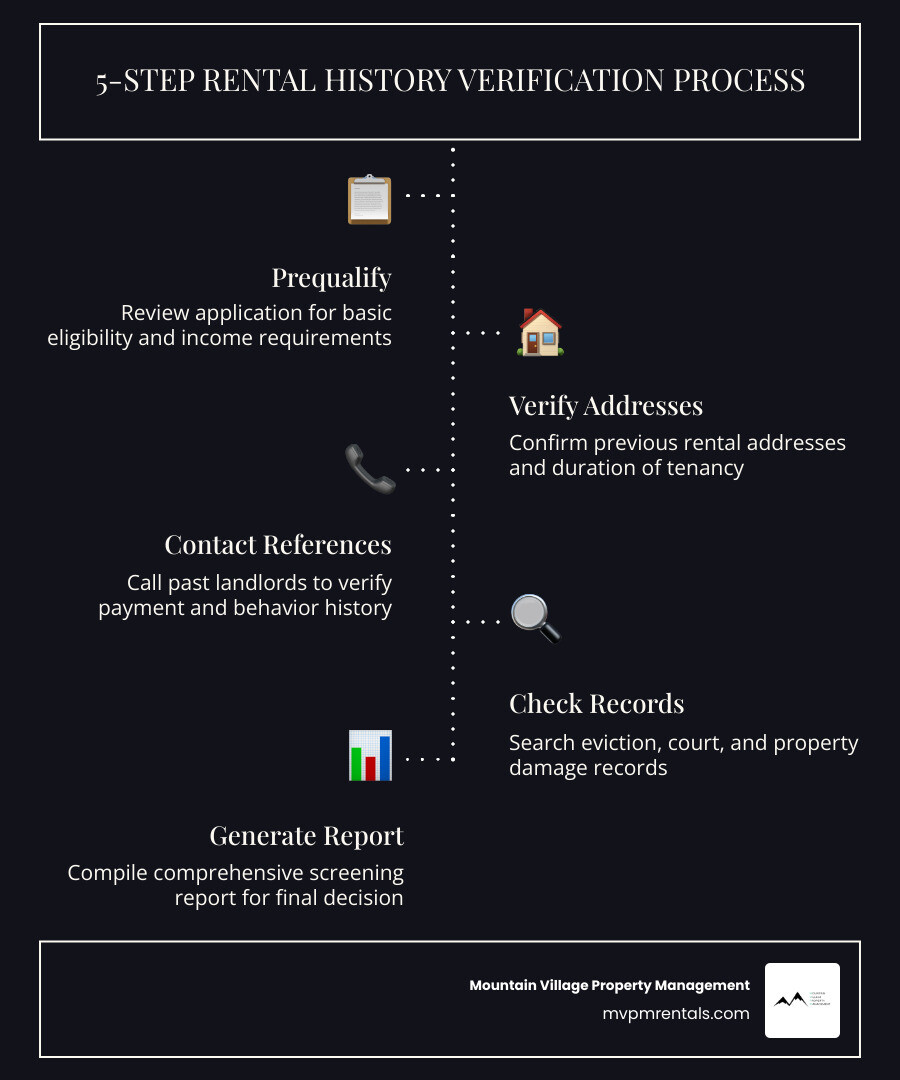
Conducting a rental history background check isn’t just about reading a report; it’s about detective work. At MVPM, we follow a rigorous process to ensure the information we receive is accurate.
- The Application: Start with a comprehensive rental application. It should ask for at least three years of residency history, including the names and contact information for all previous landlords.
- Identity Verification: Always cross-reference the photo ID with the application. Fraud is on the rise in the rental industry, and some applicants may try to use a “clean” identity to hide a poor rental past.
- Prequalification: Before spending money on reports, ask 14 Best Pre-Screening Questions for Tenant Applications. This helps weed out applicants who don’t meet basic income or pet requirements.
- The “Deep Dive”: Use a professional service to pull an eviction and credit report. These reports often reveal addresses that the tenant “forgot” to mention on their application.
If you are a property owner in the Gallatin Valley and want to ensure this process is handled professionally, reach out via our property owner contact form.
How to Spot Red Flags in a Rental History Background Check
Not every bad tenant has a “bad” report—sometimes the red flags are in what is missing.
- Gaps in History: If there is a six-month gap between two leases, ask why. They might have been living with family, or they might have been evicted from a place they didn’t list.
- The “Friend” Reference: Some tenants provide the phone number of a friend pretending to be a landlord. We verify ownership of the previous property through public tax records to ensure we are talking to the actual owner.
- Inconsistent Dates: If the credit report shows they lived in Belgrade in 2022, but the application says they were in Three Forks, that’s a red flag.
- Late Payment Patterns: One late payment three years ago is a mistake. Monthly late payments are a lifestyle.
For a visual guide on what to look for, you can watch this video on how to interpret a SingleKey Tenant Report, which breaks down the data points that matter most.
Contacting Previous Landlords
The current landlord might just want the tenant gone, so they might give a glowing (and false) review. The previous landlord (the one before the current one) is usually your best source of honest information. They have no “skin in the game” and will tell you the truth about noise complaints, property damage, or unauthorized pets.
Key questions we ask include:
- Did the tenant provide a proper notice of intent to vacate?
- Would you rent to this person again? (This is the most telling question).
- Was the security deposit returned in full?
Our tenant services team is trained to navigate these conversations to get the real story behind the application.
The Role of Professional Screening Services and Databases
While manual checks are great, technology has made the rental history background check much more efficient. We utilize several databases to get a 360-degree view of an applicant.
| Feature | Manual Reference Checks | Professional Screening Services |
|---|---|---|
| Speed | Slow (requires playing phone tag) | Instant or near-instant |
| Verification | Subjective (landlord’s opinion) | Objective (court records/credit data) |
| Eviction Data | Only what the landlord shares | National database searches |
| Fraud Detection | Hard to spot fake IDs | Built-in identity verification |
| Cost | Free (but time-intensive) | $25 – $50 per applicant |
Platforms like the FrontLobby tenant screening tools allow landlords to see if a tenant has a history of rent reporting. This is a game-changer because it shows actual monthly payment tradelines, much like a car loan or credit card.
Integrating a Rental History Background Check with Credit and Criminal Reports
A rental history background check is only one piece of the puzzle. You must integrate it with credit and criminal reports to see the full picture.
We look for a VantageScore (similar to a FICO score) to determine financial reliability. Ideally, a tenant should have a score above 600, though we look at the whole profile. For example, a medical debt might be less concerning than a history of unpaid utilities. You can view a sample tenant screening report to see how these data points are presented.
In Montana, criminal record checks are permitted, but they must be handled carefully. We focus on offenses that could pose a direct threat to the property or other residents, rather than minor, unrelated infractions from years ago.
Verifying Income and Employment
The “30% Rule” is a standard guideline in the industry: a tenant’s monthly rent should not exceed 30% to 33% of their gross monthly income.
To verify this, we require:
- The two most recent pay stubs.
- For self-employed applicants, the last two years of tax returns.
- An employment verification letter on company letterhead.
If you’re unsure how to calculate these ratios or want us to handle the verification for you, contact Mountain Village Property Management today.
Frequently Asked Questions about Tenant Screening
What specific information does a rental history check reveal?
It reveals the “habits” of a tenant. Beyond just “did they pay,” it shows if they were a good neighbor, if they followed HOA rules in places like Big Sky or Gallatin Gateway, and if they took care of the appliances and flooring. It also flags formal evictions, which are often omitted from standard applications.
How can landlords detect fake references?
We use “reverse lookups” on phone numbers. If a landlord’s name is “John Smith” but the phone number is registered to a “Tim Jones,” we dig deeper. We also ask specific questions about the property (like the color of the front door or the type of heating) that a fake reference wouldn’t know. Searching the FrontLobby database can also confirm if a landlord is a registered user.
What should tenants do to prepare for a background check?
Be proactive!
- Check your own credit: Use Equifax credit services or TransUnion to ensure there are no errors.
- Gather letters: Ask your current landlord for a reference letter in advance.
- Be honest: If you have a past eviction or a credit hiccup, tell the property manager upfront. Honesty goes a long way in building trust.
- Rent Reporting: Learn more about rent reporting and how it can help you build credit by simply paying your rent on time.
Conclusion
A thorough rental history background check is the foundation of a successful rental investment. By combining manual reference checks with professional databases and legal compliance, you can protect your property and your peace of mind.
At Mountain Village Property Management, we take the guesswork out of landlording. Whether you have a single-family home in Belgrade or a luxury condo in Big Sky, our full-service management offers:
- A low 4.9%–8.9% management fee.
- no set-up fee (Signature & Summit plans).
- High occupancy rates through aggressive marketing.
- Rigorous tenant screening that minimizes the risk of costly evictions.
Don’t leave your investment to chance. Let us handle the details so you can enjoy the rewards.
Contact us today:
- Email: admin@mvpmrentals.com
- Web: Start your stress-free property management journey
We serve Bozeman, Belgrade, Butte, Livingston, Big Sky, Gallatin Gateway, Three Forks, Manhattan, and the surrounding Montana areas. Let’s make your rental property a success together.