
Why Property Investment Help Matters for Your Success
Property investment help connects you with the guidance and support needed to build wealth through real estate, whether you’re buying your first rental or expanding your portfolio. Here’s what you need to succeed:
- Financial preparation: Improving your credit score, planning for a down payment, and understanding loan options
- Strategy selection: Choosing between buy-and-hold, renovate-and-rent, or passive investing
- Professional team: Working with agents, lenders, accountants, and property managers
- Property management: Deciding between self-management and hiring professionals
- Tax optimization: Leveraging depreciation, deductions, and 1031 exchanges
Long-term market data shows that U.S. residential property prices have risen steadily, offering lower volatility compared to stocks. The market has shown resilience, with home prices rebounding to all-time highs by 2022 after the COVID-19 pandemic.
However, successful property investment is more than just buying a house and collecting rent. It requires understanding financing, identifying the right markets, choosing a strategy, and managing daily responsibilities—or finding the right help to do it for you.
First-time investors often overlook costs like insurance, taxes, and maintenance reserves, or underestimate the time needed for management. Without proper guidance, a profitable investment can quickly become a financial burden.
The good news? You don’t have to figure this out alone. Whether you’re exploring markets in Bozeman and Southwest Montana or investing from out of state, the right property investment help can mean the difference between struggling with vacancies and enjoying steady cash flow.
I’m Pablo Negrete, co-owner of Mountain Village Property Management. We help property owners in Southwest Montana maximize rental income with a 98% occupancy rate. I’ve seen how the right support transforms real estate from a stressful side hustle into a reliable wealth-building tool.
Why Invest in Real Estate? The Foundation of Wealth Building
Real estate has long been considered a sound investment, offering unique advantages for building wealth. Unlike more volatile assets, the real estate market generally features low volatility and remains stable.
The Power of Appreciation and Cash Flow
One of the most compelling reasons to invest in real estate is the dual benefit of appreciation and cash flow.
Appreciation is the increase in a property’s value over time. Historical data from the Federal Reserve Bank of St. Louis’s FRED tool shows a long-term rise in U.S. residential property prices. A well-chosen property’s market value is likely to grow, allowing you to build equity. The market has also shown resilience, with prices reaching all-time highs by 2022 after the initial impact of the COVID-19 pandemic.
Cash flow is the passive income generated from rent payments. When rent covers your mortgage, taxes, and insurance with profit left over, you have positive cash flow. This income can pay down your mortgage, fund other investments, or boost your monthly earnings. Essentially, your tenants help pay down your mortgage while the property appreciates in value.
Hedging Against Inflation and Diversifying Your Portfolio
Real estate also serves as an excellent hedge against inflation and a powerful tool for portfolio diversification.
Inflation Hedge: Real estate is an excellent hedge against inflation. As inflation rises, so do rents and property values, which helps protect the purchasing power of your capital. When the cost to build new homes increases, the value of existing properties also tends to rise.
Portfolio Diversification: Adding real estate to your portfolio provides powerful diversification. It has a low correlation with other assets like stocks, meaning it often performs well when the stock market is down. This balances overall risk and can provide competitive risk-adjusted returns, adding stability to your portfolio.

This tangible asset often trades at a yield premium to U.S. Treasuries, making it attractive in low-rate environments and providing a sense of security that abstract financial instruments may not.
Getting Started: Your Pre-Investment Checklist
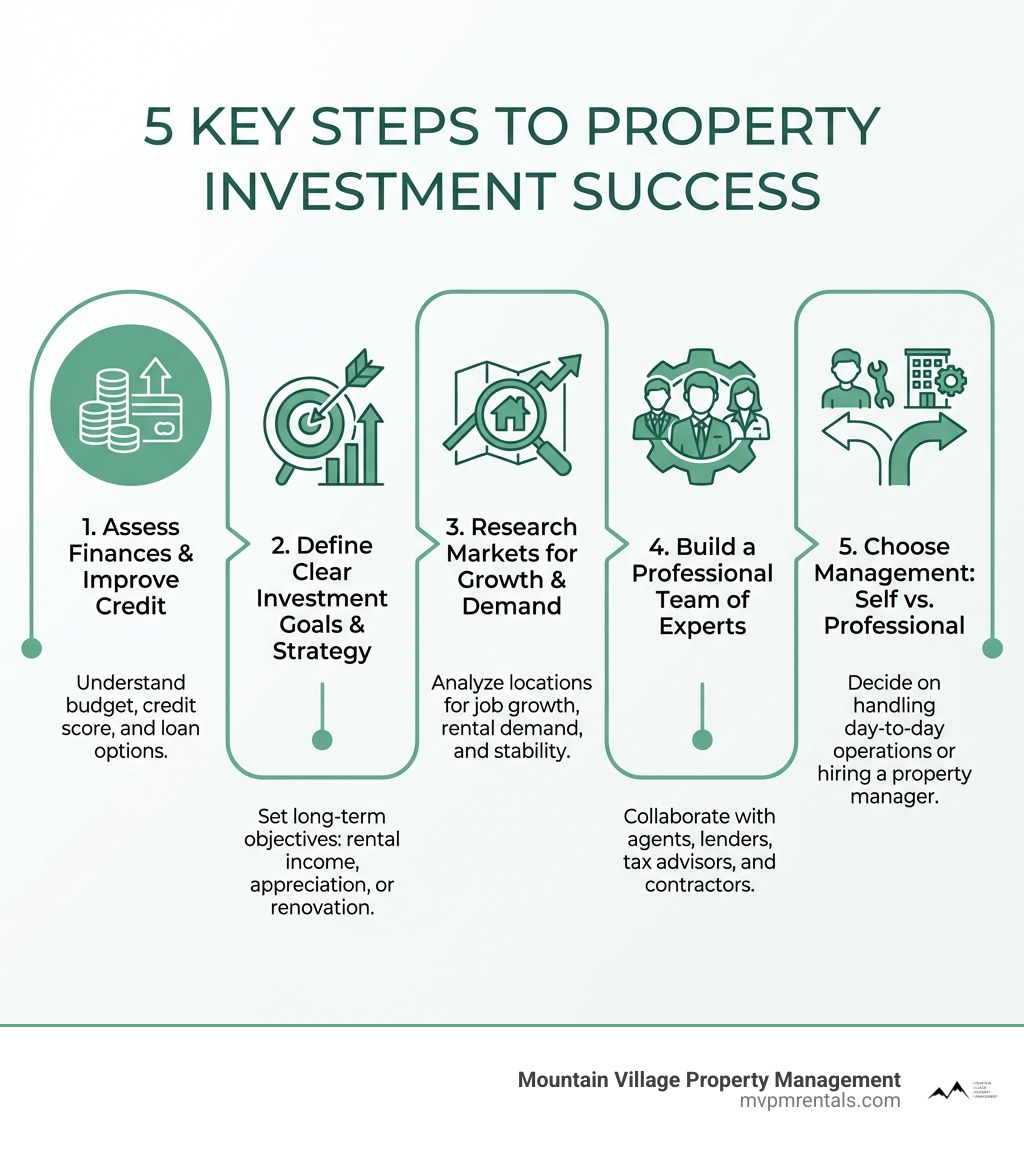
Starting your real estate investment journey in markets like Bozeman and Southwest Montana requires careful planning. Before looking at properties, you must complete a financial assessment, define your goals, research the market, and select a strategy. This pre-investment checklist is foundational property investment help.
Financial Property Investment Help: Getting Your Finances in Order
First, get your finances in order. This is the most critical step.
Your credit score is critical for lenders, with most requiring a 650 or higher. Improve your score by making timely payments and lowering credit utilization. A strong score leads to better loan terms, saving you money.
Next, manage your debt-to-income ratio. A lower ratio improves your chances of securing favorable loan terms.
Then, save for a down payment. While 20% is common for conventional loans, some options require as little as 5%. For “house hacking” (living in one unit of a multi-unit property), FHA loans may allow a down payment as low as 3.5%.
Don’t forget to budget for closing costs, which can amount to thousands of dollars. Plan for these expenses to avoid surprises.
Finally, build a financial cushion. This reserve covers unexpected repairs, vacancies, and other costs beyond the down payment and closing, providing essential peace of mind.
Defining Your Investment Goals
Before searching for properties, define what you want to achieve. Your goals will shape your entire strategy.
Decide between capital growth vs. cash flow. Are you aiming for long-term value increase or immediate, steady income? This choice will determine the type of property you seek.
Assess your risk tolerance. Do you prefer a high-return fixer-upper that requires more work, or a hassle-free, turn-key property with lower immediate returns?
Consider strategies like house hacking, where you live in one unit of a multi-unit property and rent out the others. This reduces your living expenses while you build equity and gain landlord experience, making it a great entry point for new investors in markets like Bozeman.
View property investment as a long-term strategy for financial security. Align your goals with your retirement planning to find the right properties.
Mastering Market Research
Location is everything. Market research is imperative to find the right location for your first investment property, such as Bozeman, Belgrade, Butte, or other areas in Southwest Montana.
When researching, look for key indicators:
- Job and population growth: Growing areas have higher housing demand. For example, Bozeman’s strong job market and low unemployment rate create a stable pool of renters.
- Vacancy rates and rental demand: Low vacancy rates signal high demand. Research local demand and current vacancies to ensure consistent income.
- Schools and amenities: Proximity to good schools, shopping, and recreation makes properties more attractive and helps them appreciate. Bozeman’s amenities and Montana State University provide a consistent tenant pool.
- Local economic health: Look for areas with sustainable employment and business growth. Understand your target renter demographic, whether students, families, or professionals.
The Bozeman market is a prime example of an investor-friendly environment with opportunities for cash flow and appreciation, where thorough research pays off.
Common Real Estate Investment Strategies Explained
Once your finances are in order and your goals are clear, it’s time to choose an investment strategy. Each approach has its own risk profile, capital requirements, and time commitment.
| Strategy | Risk Level | Capital Required | Time Commitment | Primary Goal |
|---|---|---|---|---|
| Buy and Hold | Low to Medium | Medium | Low (with PM) | Passive Income, Appreciation |
| Renovate and Rent | Medium to High | High | Medium to High | Increased Cash Flow, Appreciation |
| Local Passive Investing | Low to Medium | Low to Medium | Very Low (with PM) | Passive Income, Diversification |
Buy and Hold (Long-Term Rentals)
This common strategy involves buying a property to rent out long-term, benefiting from both rental income and property appreciation. The appeal is generating steady cash flow while tenants help pay down your mortgage, building your equity. While it requires ongoing management, the long-term rewards are substantial. For beginners, turn-key properties are ideal as they are rent-ready, allowing you to generate income immediately without the hassle of renovations. In growing areas like Bozeman, this strategy can lead to significant property appreciation over time.
Renovate and Rent
This strategy involves buying a property, renovating it to increase its value and rental income, and then renting it out long-term. It’s vital to calculate the after-repair value (ARV) and renovation costs. A common guideline is the 70% rule, which suggests you should not pay more than 70% of the ARV minus repair costs. While riskier due to potential renovation overruns, this approach can significantly boost your cash flow and equity. Once rented, it becomes a buy-and-hold investment with higher returns.

Local Passive Investing Options
For a truly hands-off approach, consider partnering with a professional property management company. This is the core of property investment help. While you own the asset, you delegate all day-to-day responsibilities to experts. This allows you to earn rental income without the grind of tenant screening, rent collection, or maintenance. It’s an ideal solution for busy professionals or out-of-state investors. Companies like Mountain Village Property Management specialize in turning your property into a reliable, passive income stream, giving you the benefits of ownership without the headaches.
Navigating Your First Purchase: Where to Find Property Investment Help
Once you’ve settled on a strategy, the next hurdle is acquiring the property. This phase involves securing financing, conducting due diligence, and assembling a professional team. It’s a complex stage where expert property investment help is invaluable.
Securing Financing for Your Investment
Understanding your financing options is key. Conventional loans are common, often requiring a 20% down payment, though some options go as low as 5%. FHA loans are great for “house hacking” a multi-unit property, with down payments as low as 3.5%.
Get pre-approval for a loan before you shop to clarify your budget and show sellers you’re serious. Compare lenders—from national banks to local credit unions—to find the best interest rates and terms for your strategy, and always factor rising rates into your profitability calculations.
Strategic Property Investment Help: Building Your Professional Team
Building a strong professional team is one of the smartest moves an investor can make. This team provides essential property investment help at every stage:
- Real estate agent: An agent with investment property experience in your target market can help you find and negotiate deals.
- Mortgage broker/lender: These professionals will help you secure the best financing terms.
- Real estate accountant: An accountant specializing in real estate can provide invaluable advice on tax implications and financial structuring.
- Attorney: A real estate attorney can review contracts and ensure legal compliance.
- Professional property managers: A good property manager handles everything from tenant screening to maintenance, ensuring your investment runs smoothly.
Your team acts as a brain trust, offering specialized knowledge to prevent costly mistakes and accelerate your success.
The Keys to Success: Managing Your Investment
Once you’ve purchased your property, effective management is crucial for maximizing returns. This involves tenant relations, maintenance, legal compliance, and financial tracking.
The Landlord Role: Self-Management vs. Professional Help
Deciding whether to manage your property yourself or hire a professional is a pivotal choice.
Self-management means you’re responsible for every aspect of the rental, including:
- Tenant screening: Conducting background and credit checks.
- Rent collection: Ensuring timely payments.
- State-specific leases: Drafting and enforcing legal leases.
- Maintenance requests: Coordinating all repairs.
- Eviction process: Navigating legal complexities if necessary.
- Time commitment: Self-management can be a significant time drain.
While self-management saves on fees, it demands significant time and expertise. The risks of bad tenants, maintenance hassles, and legal issues make professional help an attractive alternative.
Professional property managers like Mountain Village Property Management handle all these responsibilities for you. We ensure your property is well-maintained and profitable, allowing you to enjoy the benefits of ownership without the operational burden. Learn More info about our Services to see how we make investing hassle-free.
Understanding Financials and Tax Implications
Proper financial tracking and understanding tax implications are vital. A real estate accountant can provide critical property investment help.
Cash flow is the lifeblood of your investment. Use operating cash flow reports to track your property’s profitability.
Depreciation is a major tax advantage that allows you to deduct a portion of your property’s value each year (over 27.5 years for residential rentals). This non-cash expense reduces your taxable income.
You can also deduct many deductible expenses, including mortgage interest, property taxes, insurance, repairs, and management fees. Proper tracking ensures you maximize your tax savings.
To defer capital gains tax when you sell, you can use a 1031 exchange. This allows you to reinvest the proceeds into a new “like-kind” property. This powerful strategy helps you grow your portfolio without an immediate tax hit, but it has strict rules and timelines: you must identify a new property within 45 days and close within 180 days.
Always use a dedicated business bank account for your investments. This simplifies financial tracking and makes tax time easier.
Frequently Asked Questions about Property Investment
We understand that diving into real estate can bring up a lot of questions. Here are some of the most common ones we encounter.
How much money do I need to start investing in real estate?
The amount needed varies. While a 20% down payment is traditional, some loans require as little as 5%, and FHA loans for “house hacking” can be as low as 3.5%. Beyond the down payment, you must budget for closing costs, a potential renovation budget, and cash reserves. We advise having 3-6 months of operating expenses saved as a cushion for unexpected costs and vacancies. A solid financial plan is essential.
Is real estate a better investment than stocks?
Both asset classes have their merits. Real estate offers unique advantages that make it an attractive complement to stocks:
- Lower volatility: The real estate market is generally more stable than the often-turbulent stock market.
- Inflation hedge: Rents and property values tend to rise with inflation, protecting your capital’s purchasing power.
- Tangible asset: You own a physical property, which provides a sense of security.
One drawback is less liquidity; selling a property takes much longer than selling stocks. Real estate also carries risks like problem tenants and high repair costs. For these reasons, diversification is key. Including both real estate and stocks in your portfolio can balance risk and improve overall returns.
What are the biggest risks for a new property investor?
New investors face several key risks:
- Problem tenants: Late payments, property damage, or evictions can be stressful and costly. Thorough tenant screening is your best defense.
- Unexpected vacancies: A vacant property generates no income, but expenses continue. A financial cushion is crucial to cover these periods.
- High repair costs: Unexpected issues like a new roof or broken furnace can quickly erase profits. Budgeting for maintenance is essential.
- Market downturns: While generally stable, real estate markets can dip, affecting your ability to sell or refinance.
- Miscalculating expenses: Overlooking costs like taxes, insurance, and maintenance can lead to negative cash flow.
The good news is that these risks can be mitigated with proper property investment help, including thorough research, a solid financial plan, and a reliable professional team.
Conclusion: Your Path to Real Estate Success
Real estate investing can seem daunting, but with the right property investment help, it’s a powerful way to build wealth. We’ve covered the key steps: understanding the benefits like cash flow and appreciation, completing your pre-investment checklist, choosing a strategy, building a team, and managing your property effectively. Having a plan is crucial for success in markets like Bozeman and Southwest Montana.
Real estate is a long-term game requiring patience and diligence. Each property helps you build equity, generate income, and move closer to your financial goals.
For investors in the Bozeman area, Mountain Village Property Management offers expert, full-service solutions to maximize rental income without the hassle. With our low 8% management fee, $0 setup costs, and high occupancy rates, we ensure your investment works for you.
Don’t let complexity hold you back. Let us provide the property investment help you need to succeed.