
Why Rental Property Accounting Matters for Your Investment Success
Rental property accounting is the systematic tracking, organizing, and analyzing of all financial transactions related to your rental properties—from rent payments and security deposits to repair costs and mortgage interest. Here’s what you need to know:
Quick Answer: Essential Components of Rental Property Accounting
- Track all income – rent, late fees, pet fees, parking, and other charges
- Categorize every expense – repairs, insurance, property taxes, utilities, management fees
- Maintain separate bank accounts – keep rental finances apart from personal funds
- Digitize receipts and documents – use apps or cloud storage for easy access
- Calculate depreciation – residential rentals depreciate over 27.5 years
- Generate monthly reports – income statements, cash flow, and expense summaries
- Prepare for tax season – organize records for Schedule E and maximize deductions
While not the most exciting part of real estate, good money management leads to tax savings, increased rental income, and higher ROI. Poor management does the opposite, shrinking your returns.
The good news? You don’t need to be an accountant to get this right. With the right systems and tools, rental property accounting becomes straightforward. Whether you own a single-family home in Bozeman or a growing portfolio across Southwest Montana, accurate financial tracking is the foundation of a profitable rental business.
This guide covers setting up bank accounts, digitizing receipts, understanding depreciation, and maximizing tax deductions. You’ll learn to distinguish deductible expenses from capitalized ones and use financial data to make smarter decisions.
I’m Pablo Negrete, co-owner of Mountain Village Property Management, where we’ve helped property owners throughout Southwest Montana streamline their rental property accounting while maintaining a 98% occupancy rate. Over the years, I’ve seen how proper financial management transforms a landlord’s investment from a source of stress into a reliable wealth-building tool.
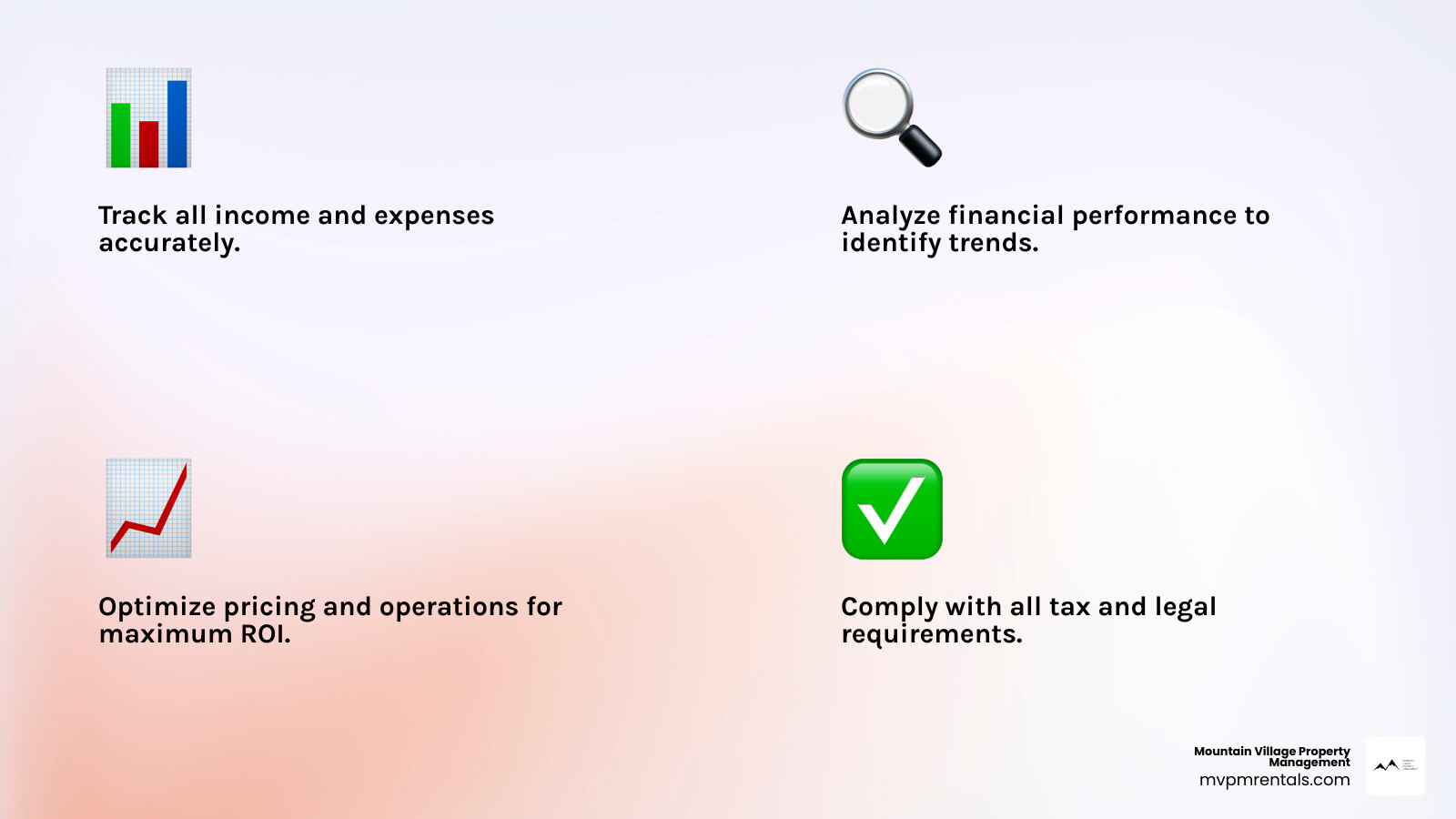
The Foundations: Why Smart Rental Property Accounting is Non-Negotiable
Smart rental property accounting is the bedrock of a thriving real estate investment. It ensures financial operations are organized, transparent, and optimized for profitability. It’s critical for tax compliance, risk reduction, and simplified management, especially for portfolios across Bozeman, Belgrade, Butte, and our other service areas.
Managing rental finances—from small repairs to complex tax codes—can be overwhelming. A robust accounting system turns this chore into a powerful strategic tool.
The Core Principles of Landlord Bookkeeping
At Mountain Village Property Management, we believe in a few fundamental principles that guide effective rental property accounting:
- Consistency: We record all transactions regularly and uniformly. Whether it’s weekly or monthly, a consistent schedule prevents backlogs and ensures accuracy.
- Accuracy: Every entry must reflect the true financial activity. Mistakes can lead to incorrect financial reporting, missed deductions, and potential issues with the IRS.
- Separation of Funds: We always keep business finances distinct from personal funds. This is a golden rule that simplifies tracking and protects assets.
- Documentation: Every income stream and expense must be backed by evidence, such as receipts, invoices, or bank statements.
- Regular Reviews: We don’t just record; we analyze. Regularly reviewing financial reports helps us catch errors early and identify trends.
Why Meticulous Record-Keeping is Crucial
Meticulous record-keeping is crucial for several reasons, extending far beyond simply knowing how much money we have.
- Audit-Proofing: The IRS can audit rental property owners. Having well-organized, accurate records with supporting documentation is our best defense, providing evidence that our claimed expenses are valid.
- Substantiating Deductions: Every dollar we can legitimately deduct lowers our taxable income. Without proper records, we risk missing out on valuable deductions or having them rejected.
- Tracking Profitability: Detailed records allow us to evaluate the financial health of each property and our entire portfolio. We can see which properties are performing well and which might need strategic adjustments.
- Informed Decision-Making: When we understand our income and expense patterns, we can make smarter decisions about rent pricing, where to invest in upgrades, and when to expand our portfolio.
- Legal Compliance: Beyond taxes, accurate records are vital for legal compliance, especially concerning security deposits and tenant disputes.
Essential Components of a Rental Property Accounting System
A reliable rental property accounting system, whether managed by us or a dedicated landlord, should include:
- Chart of Accounts: This is a list of all accounts used to categorize financial transactions. We often recommend structuring this to align with IRS Schedule E categories for easier tax preparation.
- Income Tracking: A robust system to record all sources of income, not just monthly rent.
- Expense Tracking: A method to document every operating expense, capital expense, and other outlay.
- Document Storage: A secure system for storing all receipts, invoices, lease agreements, and other important documents, ideally digitized for easy access.
- Financial Reporting: The ability to generate key financial statements like Income Statements (P&L), Balance Sheets, and Cash Flow Statements.
- Bank Reconciliation: A process to regularly match our bank statements with our accounting records to ensure accuracy and catch discrepancies.
Building Your Financial Framework: Setup and Best Practices

Setting up a solid financial framework from the start makes all the difference. It’s about more than just tracking; it’s about building a scalable system that supports growth and minimizes headaches.
Structuring Your Banking for Success
One of the most fundamental steps in rental property accounting is separating personal and business finances. We strongly recommend this, even if you’re a sole proprietor.
- Separate Business Bank Accounts: Create a dedicated checking, savings, and even a credit card account solely for your rental business. This simplifies accounting, prevents the need to filter through irrelevant transactions, and makes tax preparation much easier. Mixing accounts is “not a great idea” and can lead to scrutiny during an audit.
- Property-Specific Accounts: For landlords with multiple properties, especially across our service areas like Bozeman, Butte, or Livingston, we often advise considering separate bank accounts for each rental property. This helps silo finances, making it easier to track the performance of individual assets.
- LLC Considerations: If you’re operating as an LLC, using separate bank accounts is strongly recommended for both liability protection and tax reporting. This ensures the legal distinction between you and your business is maintained. When considering forming an LLC for your rental property business, it’s wise to consult with a professional who understands the local legal landscape.
- Consult with a Professional: For setting up the legal and banking structure that best suits your specific situation, we always recommend consulting with a legal expert and a banking professional.
Tracking Income and Expenses Effectively
Effective tracking is the heart of rental property accounting. It’s about capturing every financial detail and categorizing it correctly.
- Categorizing Income: Rental income isn’t just the monthly rent payment. We track all sources, including:
- Rent payments
- Advance rent (taxable in the year received, regardless of period covered)
- Late fees
- Pet fees
- Parking fees
- Laundry facilities income
- Security deposits kept due to lease violations (not income until kept)
- Payments for lease cancellation
- Expenses paid by a tenant on your behalf (these are income to you, but also deductible expenses)
- Fair market value of property or services received as rent (e.g., a tenant painting in exchange for rent).
- Categorizing Expenses: Every outflow of cash needs a category. We use a chart of accounts, often modeled after IRS Schedule E, to ensure we capture all deductible expenses. Common categories include:
- Property management fees
- Maintenance and repairs
- Utilities paid by the owner
- Insurance premiums
- Property taxes
- Advertising costs for vacant units
- Mortgage interest
- Legal and professional fees
- Travel expenses (e.g., mileage for property visits)
Streamlining Operations with Digital Tools
There’s no reason to drown in paper. Digital tools make rental property accounting vastly more efficient.
- Digitizing Receipts: We encourage landlords to digitize all receipts and develop an accessible system for them. Apps allow you to snap a picture of a receipt, categorize it, and store it securely in the cloud. For easy retrieval, we suggest appending the date and property address to digital file titles. This eliminates paper clutter and makes tax time much smoother.
- Secure Cloud Storage: Utilizing a digital filing cabinet for property documents, including leases, invoices, and tenant communications, ensures everything is backed up and accessible from anywhere.
- Online Rent Collection: For landlords, online rent collection options streamline financial management significantly. Instead of chasing checks, we can automate rent collection and reminders. This ensures accurate income tracking against leases and tenants, avoiding manual data entry errors and simplifying reporting for tax purposes. At Mountain Village Property Management, our online rent collection system is a key feature we offer to our clients.
- Scheduling Financial Tasks: We advise landlords to schedule dedicated time each week or month for managing finances. Consistent, smaller tasks are far easier to manage than a year-end scramble.
From Data to Decisions: Measuring Performance and Maximizing ROI
Rental property accounting isn’t just about compliance; it’s a powerful tool for strategic decision-making. By carefully analyzing financial data, we can understand property performance, identify opportunities, and ultimately maximize our return on investment.
Key Financial Metrics Every Landlord Must Know
To truly evaluate property performance, we look beyond just the bottom line. Here are the key financial metrics every landlord should understand:
- Net Operating Income (NOI): This is a property’s income after deducting all operating expenses, but before debt service (mortgage payments) and income taxes. It tells us how profitable a property is purely from its operations.
- Cash Flow: The actual cash generated by a property after all expenses, including mortgage payments, are paid. Positive cash flow is essential for liquidity.
- Cash-on-Cash Return: This metric measures the annual pre-tax cash flow against the total cash invested. It’s excellent for comparing the performance of different investments.
- Capitalization Rate (Cap Rate): Calculated by dividing the NOI by the property’s current market value, the cap rate helps us compare the relative value of different investment properties.
- Return on Investment (ROI): A broad measure of the profitability of an investment, ROI helps us understand the overall financial gain or loss relative to the initial cost.
Generating and Understanding Financial Statements
These metrics come alive through accurate financial statements, which provide a comprehensive view of our properties’ financial health.
- Income Statement (P&L): This report summarizes a property’s revenues, costs, and expenses over a specific period, showing its profitability or loss. We review these monthly to catch issues and make informed decisions.
- Balance Sheet: A snapshot of a property’s assets, liabilities, and owner’s equity at a specific point in time. It shows our financial position.
- Cash Flow Statement: This statement reports the cash generated and used by a property over a period, categorizing cash flows into operating, investing, and financing activities. It’s vital for monitoring liquidity.
We typically recommend a regular review schedule, ideally monthly, to keep a pulse on financial performance.
How Accounting Data Maximizes Your Return on Investment (ROI)
The insights gained from good rental property accounting directly translate into a higher ROI.
- Identifying Expense Leaks: Detailed expense tracking allows us to spot areas of overspending or inefficiencies. For example, if utility costs are consistently high, it might signal a need for energy-efficient upgrades.
- Optimizing Rent Prices: By analyzing our income statements and comparing them with market data, we can determine if our rental rates are aligned with the local market in Bozeman or surrounding areas. If they are underpriced, we can consider incremental rent increases or strategic upgrades to justify higher rates.
- Pinpointing Profitable Upgrades: Accounting data helps us evaluate the ROI of potential capital improvements. Is a new HVAC system worth the upfront cost if it significantly reduces future utility expenses and attracts higher-paying tenants? Our data helps answer that.
- Strategic Planning: With a clear financial picture, we can make informed decisions about expanding our portfolio, refinancing, or even selling a property. Treating our accounting system as a strategic tool rather than a chore truly open ups our property’s full potential.
Tax Time Simplified: Deductions, Depreciation, and Compliance

Tax season can be daunting, but with organized rental property accounting, it becomes a manageable process. Our goal is always to maximize eligible deductions and ensure full compliance.
Understanding Your Tax Obligations
As landlords, we have specific tax responsibilities. All rental income must be reported, and associated expenses can generally be deducted.
- Reporting Rental Income: We report all rental income on our federal tax return, typically using IRS Form 1040, Schedule E, Part I. This includes not just rent, but also advance rent, security deposits kept, and tenant-paid expenses.
- Federal Tax Forms: Beyond Schedule E, we might use Form 4562 for depreciation, and be aware of other forms like Form 6198 for at-risk limitations or Form 8582 for passive activity loss limitations.
- State and Local Taxes: While federal obligations are paramount, we also need to be aware of any state and local tax implications specific to Montana. For more information on how we manage these and other aspects for our clients, please visit our services page.
Capital Improvements vs. Deductible Expenses
A common area of confusion in rental property accounting is distinguishing between repairs and improvements. The IRS has clear guidelines, and miscategorizing these can lead to audit issues or missed tax benefits.
| Category | Capital Improvements | Deductible Repairs |
|---|---|---|
| Definition | Expenses that add value, prolong useful life, or adapt property to a new use | Expenses for maintaining or restoring property to its existing condition |
| Tax Treatment | Not immediately deductible; capitalized and recovered through depreciation over time | Immediately deductible in the year paid as ordinary and necessary expenses |
| Examples | New roof, HVAC system, kitchen remodel, room addition, extensive renovations | Fixing a leaky faucet, painting a room, replacing broken window pane, routine maintenance |
| Betterments | Improvements that materially add to the value or prolong the useful life | |
| Restorations | Returning property to its original condition after a casualty or wear | |
| Adaptations | Changing property to a new or different use |
Maximizing Deductions: What You Can Claim
Beyond repairs, many other expenses can significantly reduce our taxable income. Here are common tax deductions we ensure our landlords claim:
- Mortgage Interest: A substantial deduction for most landlords.
- Property Taxes: State and local property taxes paid are deductible.
- Insurance: Premiums for landlord insurance, fire, theft, and flood insurance.
- Maintenance and Repairs: As discussed, these are immediately deductible.
- Property Management Fees: Our low 8% management fee, for example, is fully deductible.
- Utilities: If we pay for utilities like water, gas, or electricity for the rental property.
- Travel Expenses: Costs associated with traveling to and from our rental properties for management or maintenance. For 2024, the standard mileage rate for business use of a car is 67 cents per mile, and for 2025, it’s 70 cents per mile.
- Professional Fees: Payments to attorneys, accountants, real estate advisors, or other professionals.
- Advertising: Costs to find new tenants.
The Power of Depreciation
Depreciation is one of the most powerful tax benefits for rental property owners. It allows us to recover the cost of the property over time.
- What is Depreciation: It’s an annual income tax deduction that allows us to recover the cost or other basis of certain property over the time we use it. It accounts for the wear and tear, deterioration, or obsolescence of the property. Land, however, is not depreciable.
- Calculating Depreciation: For residential rental property, the IRS mandates a recovery period of 27.5 years. To calculate annual depreciation, we divide the property’s depreciable basis (excluding land value) by 27.5 years. For example, if a property (excluding land) is valued at $275,000, the annual depreciation deduction would be $10,000 ($275,000 / 27.5).
- Form 4562: We use IRS Form 4562 to report depreciation for property placed in service during the year or for listed property.
- For comprehensive details, we always refer to Publication 527, Residential Rental Property, which is the definitive guide from the IRS.
Scaling Your Success: Technology, Professionals, and Property Management
As your rental portfolio grows, managing rental property accounting manually becomes unsustainable. This is where technology, professional advisors, and comprehensive property management services become invaluable.
Leveraging Technology for Rental Property Accounting
Modern property management software is a game-changer for landlords, especially those with multiple properties across our service areas.
- Benefits of using property management software provided by Mountain Village Property Management: We offer robust software solutions that automate many accounting tasks. This includes automated rent collection, expense tracking, and generation of key financial reports.
- Key Features: Our secure owner portals provide real-time access to financial data, allowing you to view income, expenses, and performance metrics for each property. Automation features, such as linking bank accounts for automatic transaction categorization, save significant time and reduce errors.
- Automation Benefits: By automating financial management, we ensure accuracy, reduce the risk of missed deductions, and free up your time to focus on other aspects of your investment strategy. This simplification is especially beneficial when managing a portfolio of properties in Bozeman, Big Sky, or Three Forks.
When to Hire a Professional
While technology streamlines much of the work, there are times when professional expertise is essential.
- Accountant or Tax Advisor: We advise seeking professional help from an accountant or tax advisor when your portfolio grows, transactions become more complex (e.g., 1031 exchanges, significant capital improvements), or if you have concerns about an audit. A real estate professional accountant, specifically, understands the nuances of property investment taxes.
- Signs You Need Help: If you find yourself overwhelmed, constantly missing deadlines, making errors, or unsure about complex tax implications, it’s time to consider professional assistance.
- For more insights into comprehensive support for your rental properties, explore our Bozeman Montana Property Management services.
The Role of a Property Manager in Your Financial Strategy
For many landlords, especially those looking for a truly hands-off investment, a property management company like Mountain Village Property Management is a vital part of the financial strategy.
- Handling Rent Collection: We manage all aspects of rent collection, ensuring timely payments and following up on overdue accounts promptly, which directly impacts your cash flow.
- Managing Vendor Payments: We handle accounts payable, paying bills on time to avoid late fees and maintain good relationships with contractors and service providers. This includes managing maintenance and repair costs, ensuring proper documentation for tax purposes.
- Providing Financial Reports: We provide regular, detailed financial reports, including income statements, expense summaries, and owner statements, giving you a clear picture of your property’s performance without the hassle of manual tracking.
- Simplifying Management: For portfolios with multiple properties, we consolidate all financial activities into a single, easy-to-understand system, simplifying rental property accounting across all your assets. Our services are designed to take the entire accounting workload off your shoulders.
- To learn more about how we can support your property’s financial success, visit our Property Management Bozeman page. With a low 8% management fee and $0 setup costs, we aim to maximize your rental income and ensure high occupancy rates, turning accounting from a burden into an asset.
Frequently Asked Questions about Rental Property Accounting
We often hear similar questions from landlords looking to optimize their rental property accounting. Here are some of the most common ones:
Should I use cash-basis or accrual-basis accounting for my rentals?
Most individual landlords use the cash-basis accounting method. This means we record income when we actually receive it and expenses when we actually pay them. It’s simpler and generally sufficient for smaller portfolios.
Accrual-basis accounting, on the other hand, records income when it’s earned (even if not yet received) and expenses when they’re incurred (even if not yet paid). This method provides a more accurate picture of financial performance over time but is more complex. For most landlords, cash-basis is the common choice. However, if you’re unsure which method is best for your specific situation, we always recommend consulting with a CPA.
What’s the most overlooked tax deduction for landlords?
Without a doubt, the most overlooked tax deduction for landlords is depreciation. Many landlords either forget to claim it or don’t fully understand how it works. This non-cash deduction can significantly reduce your taxable income each year, even if your property is increasing in value.
Other often-missed deductions include:
- Home Office Deduction: If you use a portion of your home exclusively and regularly for your rental business, you might be eligible.
- Mileage Tracking: Travel expenses for property visits, picking up supplies, or meeting contractors are deductible. Always track your mileage! As mentioned, the standard mileage rate for 2025 is 70 cents per mile.
- Pre-rental Expenses: Costs incurred before your property is ready for rent, like advertising or cleaning, can often be deducted.
The key is meticulous record-keeping for all expenses, no matter how small they seem.
How does accounting change when managing multiple properties?
When managing multiple properties, rental property accounting needs to scale significantly. What works for one property might not work for five or ten.
- Need for Scalability: The biggest change is the need for a scalable system. Spreadsheets can quickly become unwieldy and prone to errors.
- Importance of Property-Specific Tracking: It becomes crucial to track income and expenses for each individual property. This allows us to assess the performance of each asset, identify underperforming units, and make data-driven decisions about rent adjustments or repairs for specific locations like Bozeman versus Belgrade.
- Benefits of Using a Property Management Company for Portfolios: This is where a property management company like Mountain Village Property Management shines. We offer consolidated reporting that breaks down the financials per property, but also provides an overview of your entire portfolio. This simplifies management, ensures consistency, and provides the detailed insights needed to grow your investment confidently.
Conclusion: Empower Your Investment with Expert Management
Effective rental property accounting is far more than just a necessary chore; it’s a strategic asset that empowers you to maximize your investment’s potential. By adopting fundamental principles, leveraging digital tools, understanding key financial metrics, and carefully managing tax obligations, you gain unparalleled financial control and peace of mind.
We’ve explored how separating finances, digitizing records, and understanding depreciation can significantly impact your bottom line. We’ve also highlighted how the right technology and professional support can transform complex financial management into a streamlined process, especially as your portfolio grows across Bozeman, Belgrade, Butte, or any of our service areas in Southwest Montana.
For landlords in the Bozeman area, partnering with a dedicated team like Mountain Village Property Management can transform your accounting from a chore into a strategic asset, ensuring you maximize your returns with zero hassle. Our comprehensive property management services are designed to handle all aspects of financial tracking, reporting, and compliance, allowing you to focus on your investment goals.
For inquiries, call 406-602-2018 or email admin@mvpmrentals.com.