
Why Retail Property Management Fees Can Make or Break Your Investment Returns
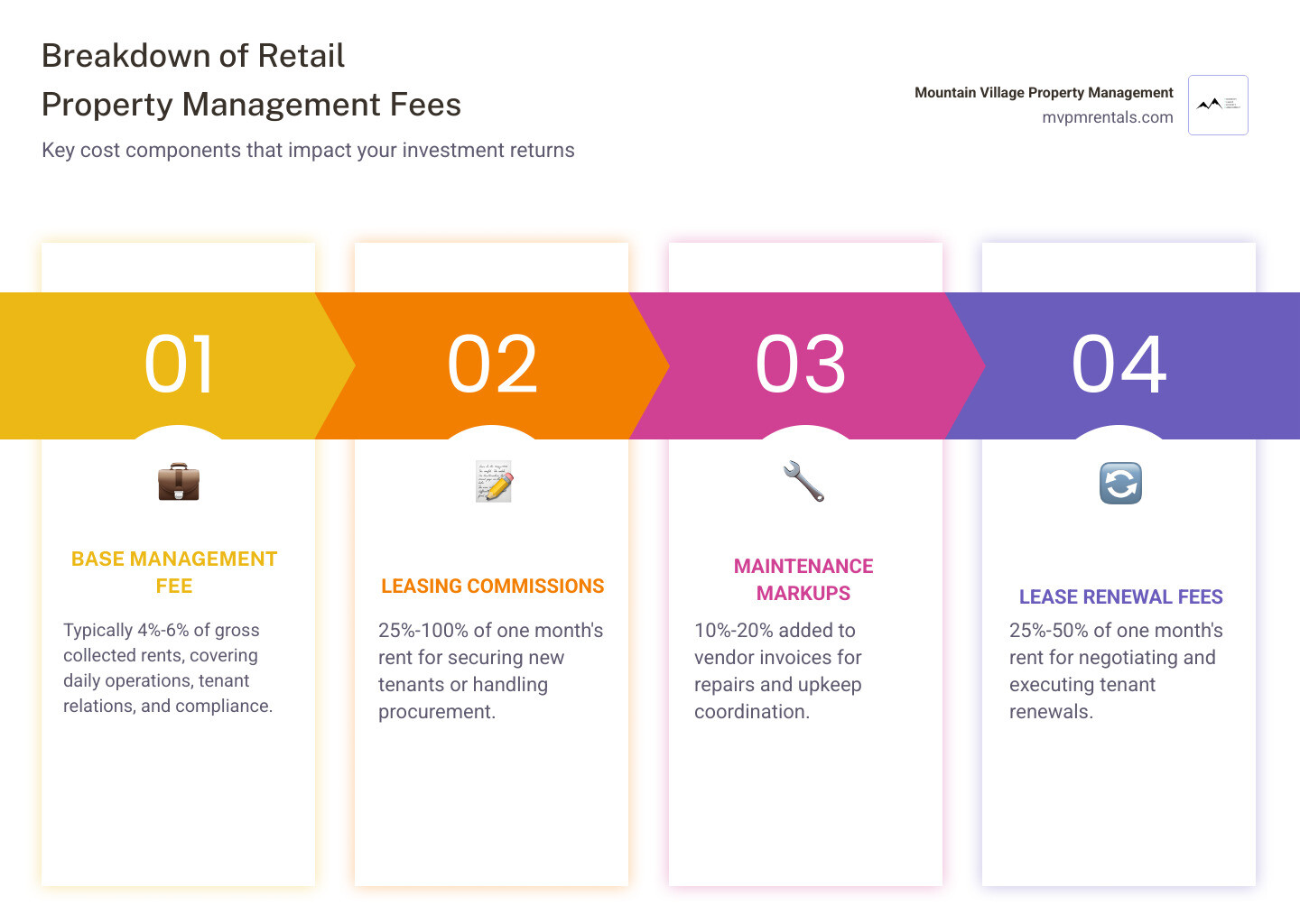
Retail property management fees typically range from 4% to 6% of gross collected rents, though the full picture is more complex. Here’s a quick breakdown:
| Fee Type | Typical Range |
|---|---|
| Base management fee | 4%–6% of gross collected rents |
| Leasing commissions | 25%–100% of one month’s rent |
| Maintenance markups | 10%–20% on vendor invoices |
| Lease renewal fees | 25%–50% of one month’s rent |
| Flat monthly fee alternative | $500–$5,000/month |
These numbers vary based on property size, location, tenant mix, and the scope of services included.
Owning a retail property can generate strong returns — but only if the costs of managing it don’t quietly eat into your profits. Between base management fees, leasing commissions, maintenance markups, and a handful of other charges, the total cost of retail property management is rarely just one number. And if you don’t know what to look for in a contract, surprises can add up fast.
This guide breaks down every layer of retail property management costs so you can budget accurately, compare providers fairly, and negotiate from a position of knowledge.
I’m Pablo Negrete, co-owner of Mountain Village Property Management in Bozeman, Montana, where I work hands-on with property owners navigating the full range of retail property management fees and commercial lease structures. My experience managing properties across Southwest Montana gives me a practical, ground-level view of what these fees actually look like — and where owners often get caught off guard.
Understanding the Structure of Retail Property Management Fees

When we talk about retail property management fees, we aren’t just looking at a single line item. The structure of these fees determines how much work the manager does and how their incentives align with yours. In the Gallatin Valley and surrounding areas like Belgrade and Big Sky, most managers use one of three primary structures: percentage-based, flat fee, or a hybrid model.
Percentage-Based Fees
This is the industry standard. Most commercial property management companies charge between 2% and 10% of total monthly revenue, though retail specifically often settles in the 4% to 6% range. For a property generating $25,000 in monthly revenue, a base fee might range from $500 to $1,500 depending on the specific agreement. This model is popular because it rewards the manager for keeping your building full and your rents high.
Flat Monthly Rates
A handful of managers charge a flat monthly fee. While this offers predictability for your accounting, be cautious. As many industry experts note, managers may have less incentive to go the extra mile if they receive the same paycheck regardless of whether the property is 100% occupied or half-empty.
Hybrid Models
Some firms use a “floor” or hybrid approach. For example, a firm might charge 4% of gross rent but guarantee a minimum of $500 per month. This protects the management company if collections dip significantly while still providing an upside for growth.
| Structure | Pros | Cons |
|---|---|---|
| Percentage-Based | Aligns manager incentives with owner revenue. | Fees increase as you successfully raise rents. |
| Flat Fee | Predictable monthly overhead for budgeting. | Less incentive for the manager to maximize collections. |
| Hybrid | Protects manager during vacancies; rewards growth. | Can be more complex to track in financial reports. |
For more details on how we structure our property management services, we always recommend looking at the specific scope of work provided.
Common Percentage Ranges for Retail Assets
As we’ve seen, typical commercial management fees generally range from 4% to 12% of gross rental income. Retail properties often fall in the middle of this spectrum. Why? Because retail centers require more “touch” than a warehouse but often have more standardized leases than a multi-tenant office building.
In Montana markets like Livingston or Manhattan, you might see fees on the higher end for smaller “mom-and-pop” strip malls (where the manager handles every small repair personally) and lower percentages for large, anchored shopping centers where on-site staff salaries are reimbursed separately.
The Difference Between Rent Due and Rent Collected
This is a critical distinction that can save you thousands. Suppose your agreement stipulates a fee based on “Rent due”. If a tenant owes $5,000 but doesn’t pay, you still owe the manager their percentage.
We strongly advocate for fees based on rents collected. If the manager doesn’t collect the money, they don’t get paid. This ensures the management team is aggressive about how to collect rent effectively and keeps your cash flow interests perfectly aligned with theirs.
How Retail Management Costs Differ from Office and Industrial
Retail property management is a different beast than managing an industrial warehouse in Belgrade or a downtown office in Bozeman. Retail centers often involve high foot traffic, complex Common Area Maintenance (CAM) reconciliations, and a diverse tenant mix that requires constant coordination.
While office-building property management services cost between 1.75% and 3% of collected rents, retail is usually higher. This is because retail managers spend significantly more time on marketing the center, managing the “tenant mix” to ensure businesses don’t compete too directly, and dealing with city officials for signage or zoning incentives.
Furthermore, Bozeman Montana Property Management involves navigating local regulations that can impact operational costs. It’s also worth noting that commercial property management fees are generally 100% tax-deductible, which helps offset the higher service costs associated with retail.
Impact of Lease Structures on Retail Property Management Fees
The type of lease you have—Triple Net (NNN), Double Net, or Gross—massively impacts the workload and, subsequently, the fees.
In a Triple Net lease, the tenant pays for taxes, insurance, and maintenance. However, the manager still has to calculate these costs, bill the tenants, and perform year-end “true-ups” or CAM reconciliations. This administrative burden is why many owners look for a perfect Bozeman property management partner who specializes in the nuances of commercial lease administration.
Common Additional Charges and Hidden Costs
The base percentage is just the beginning. To avoid surprises, you must look at the “add-on” fees. These are often where the most friction occurs between owners and managers.
Maintenance and Repair Markups
Many management companies apply a markup to vendor invoices, typically ranging from 10% to 20%. If a plumber charges $1,000 to fix a leak at a Three Forks retail shop, the manager might bill you $1,100 or $1,200. Alternatively, some firms charge an hourly rate for in-house maintenance techs. At our firm, we focus on maintenance services that provide transparency, but ask every prospective manager: “Do you markup vendor invoices?”
Leasing and Renewal Fees for Retail Tenants
When a space goes vacant, the manager has to market it, screen tenants, and negotiate the lease. Leasing fees for commercial properties typically range from 25% to 100% of one month’s rent, or 4% to 6% of the total lease value over the initial term.
Lease renewals can be a beautiful thing. You keep a good tenant and avoid vacancy. However, your manager may still charge a few hundred dollars or a small percentage (1-3%) of the new lease value to handle the paperwork and negotiations.
Other fees to watch for include:
- Eviction Fees: Evictions take effort, and managers often charge a flat fee (plus legal costs) to handle the process.
- Late Payment Fees: Some managers keep a percentage of the late fees they collect from tenants.
- Lease Terminations: Lease terminations often involve extra work to “off-board” a tenant and prepare the unit for the next occupant.
Factors Influencing Retail Property Management Fees
Not all retail buildings are created equal. A brand-new luxury shopping center in Gallatin Gateway will have a different fee structure than an older strip mall in Butte.
- Property Size: Larger properties often benefit from economies of scale. A 400,000 sq ft center might have a 2% fee (plus reimbursed on-site staff), while a 4-unit strip center might be 6%.
- Condition: Older buildings with “ancient” HVAC systems that break constantly require more management time, leading to higher fees.
- Location: Market rates in high-demand areas like Big Sky can be higher than in more rural parts of the state.
- Amenities: Property amenities play a role. A center with water features, extensive landscaping, or public parks requires more vendor coordination, which might command higher fees. Conversely, properties with amenities often command higher rents, which can sometimes push the management percentage down because the total dollar amount collected is higher.
Negotiating Your Retail Property Management Fees
Remember: everything is negotiable. Before you sign a property management contract, review every line.
- Ask for a Fee Cap: You can negotiate a maximum annual amount for certain administrative charges.
- Performance Incentives: Consider offering a bonus if the manager maintains 95% occupancy or reduces operating expenses by a certain percentage.
- Question the “Rent Due” Clause: Always push for “Rent Collected” to ensure the manager is incentivized to actually get the money in the bank.
Frequently Asked Questions about Retail Property Management
What is the average percentage for retail property management fees?
Most retail property owners should expect to pay between 4% and 6% of gross collected rents as a base fee. However, once you factor in leasing commissions and maintenance markups, the “all-in” cost often sits closer to 7% to 9%.
Are retail property management fees tax-deductible?
Yes! Under IRS guidelines, professional fees paid for the management of rental real estate are generally fully deductible as a business expense. This includes base fees, leasing commissions, and even legal fees associated with tenant matters.
Do management fees include CAM reconciliation services?
In most professional commercial real estate management agreements, annual CAM reconciliations are included in the base fee. However, some managers may charge an additional administrative fee for this complex accounting task, so it’s important to clarify this upfront.
Conclusion
At Mountain Village Property Management, we believe that professional oversight should be a value-add, not just an expense. We offer full-service management across Bozeman, Belgrade, Big Sky, and the entire surrounding region with a focus on transparency and results.
Our approach is designed to keep your investment profitable: we charge a transparent 4.9%–8.9% management fee (competitive for the high-touch retail market), no set-up fee (Signature & Summit plans), and we pride ourselves on maintaining high occupancy rates for our clients. Whether you own a single-tenant retail pad in Manhattan or a multi-tenant center in Livingston, we are here to handle the headaches so you can enjoy the returns.
Ready to see how professional management can optimize your retail asset?