
Why Rental Property Tenant Screening Can Make or Break Your Investment
Rental property tenant screening is the process of evaluating prospective renters using credit checks, background checks, income verification, rental history, and identity checks — before handing over the keys.
Here’s a quick look at what a solid screening process covers:
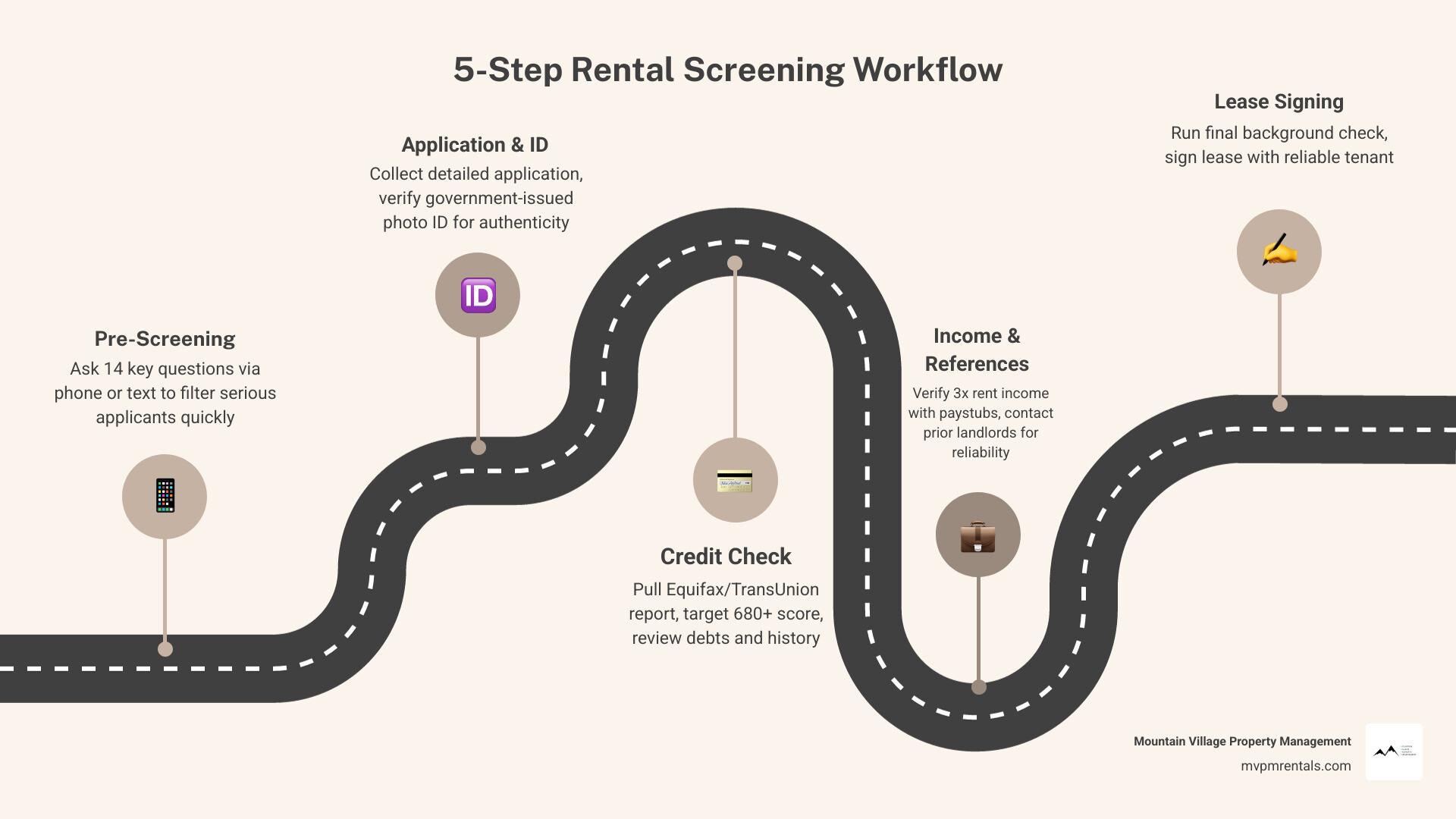
- Credit check – Review credit score (aim for 680+), payment history, and outstanding debts
- Income verification – Confirm tenant earns at least 3x the monthly rent
- Rental history – Contact previous landlords to assess reliability
- Background check – Check criminal records and eviction history
- Identity verification – Confirm government-issued ID and detect document fraud
Getting this right matters more than most landlords realize.
The average eviction costs around $11,000 — and that doesn’t count the months of lost rent, legal headaches, and stress that come with it. A bad tenant doesn’t just hurt your cash flow. They can damage your property, disturb neighbors, and consume enormous amounts of your time.
The good news? Most of those outcomes are preventable. A consistent, thorough screening process lets you spot reliable tenants before problems start — not after.
I’m Pablo Negrete, co-owner of Mountain Village Property Management in Bozeman, Montana, where rental property tenant screening has been central to how we maintain a 98% occupancy rate across Southwest Montana. In this guide, I’ll walk you through exactly how we approach it — and how you can too.
The Essential Components of Rental Property Tenant Screening
When you’re managing properties in high-demand areas like Big Sky or Gallatin Gateway, the pressure to fill a vacancy quickly is real. However, rushing the process is how “drama” starts. A comprehensive rental property tenant screening process is your best defense against the “professional tenant”—someone who knows how to exploit the system but has no intention of following the rules.

The first step is identity verification. We always require a government-issued photo ID to ensure the person applying is who they say they are. In an era of sophisticated digital forgeries, we also look for document fraud. This includes checking for inconsistent fonts on pay stubs or ID cards that look just a little “off.”
Beyond the ID, you need to navigate data privacy. While we operate primarily under Montana law, many of our modern screening tools and best practices align with high-level standards like those outlined by the Office of the Privacy Commissioner of Canada. This means obtaining clear, written consent before running any checks and ensuring that the data you collect is stored securely.
A complete screening package should include:
- Rental History: A minimum of two years of residency history.
- Reference Checks: Speaking with at least two previous landlords (not just the current one).
- Criminal Record Checks: A national search to ensure the safety of the community.
- Eviction History: Searching databases with millions of records to see if the applicant has a history of forced removals.
Conducting a Credit Check for Rental Property Tenant Screening
A credit check is one of the most powerful tools in your kit. It’s not just about a single number; it’s a story of financial responsibility. We typically look for a credit score of 680 or higher. While a lower score isn’t always an automatic “no,” it does require a closer look at the “why.”
We utilize reports from major bureaus like Equifax and TransUnion, often through integrated platforms. You can See interactive sample report to understand what a “Dual Bureau” report looks like. These reports reveal:
- Payment Patterns: Does the tenant pay their bills on time, or is there a trail of late payments?
- Outstanding Debts: Are they overleveraged with credit card debt or car loans?
- Bankruptcy History: Has the applicant filed for bankruptcy in the last seven years?
- Rental Tradelines: Some modern reports now include rent payment history directly on the credit file, which is a gold mine for landlords.
Verifying Income and Employment History
In Bozeman’s rental market, affordability is a major concern. To ensure a tenant can actually afford the home without stress, we stick to the 3x rent rule. This means the tenant’s gross monthly income should be at least three times the monthly rent.
To verify this, we don’t just take their word for it. We require:
- Recent Pay Stubs: Usually the last two or three consecutive stubs.
- Tax Returns: Especially important for self-employed applicants in places like Livingston or Manhattan.
- Employment Letters: A formal letter from their employer confirming their position, salary, and length of employment.
- Bank Statements: To verify that the income claimed is actually hitting their account.
If you’re feeling overwhelmed by the paperwork, our property management services handle all of this verification for you, ensuring that every “i” is dotted and “t” is crossed.
Legal Compliance and Fair Housing Laws
Staying “drama-free” also means staying out of court. Whether you are renting out a condo in Belgrade or a luxury home in Big Sky, you must comply with federal and state Fair Housing laws.
The Montana Residential Landlord and Tenant Act governs much of what we do locally, but the principles of non-discrimination are universal. You cannot reject an applicant based on race, color, national origin, religion, sex, familial status, or disability.
For our friends and clients who may have properties across the border or are looking for high-level privacy benchmarks, the Personal Information Protection and Electronic Documents Act (PIPEDA) provides excellent guidelines on how to handle sensitive tenant data.
To stay compliant:
- Use Consistent Criteria: Apply the same credit score and income requirements to every applicant.
- Document Everything: Keep a record of why an applicant was accepted or rejected.
- Secure Data: Store applications in encrypted, password-protected systems.
- Use Neutral Rejection Scripts: If you must decline an applicant, use a standard form that cites specific, legal reasons like “insufficient income” or “credit score below requirements.”
Identifying Red Flags and Comparing Applicants
Sometimes an applicant looks great on paper, but your gut tells you something is wrong. Usually, that “gut feeling” is actually you picking up on red flags. Identifying these early in the rental property tenant screening process is vital.
Common red flags include:
- Urgency: They want to move in tomorrow and are willing to pay cash upfront to skip the paperwork.
- Inconsistent Stories: The reason they are leaving their current place changes between the phone call and the interview.
- Fake References: They provide a “landlord” who is actually a friend. (Pro tip: Ask the “landlord” about the square footage or how many bedrooms the unit has; a friend usually won’t know).
- Gaps in History: Unexplained months or years where they seemingly lived nowhere.
To make the process objective, we use a scoring system. This allows us to compare multiple qualified applicants fairly.
| Criteria | 5 Points (Excellent) | 3 Points (Good) | 1 Point (Fair) |
|---|---|---|---|
| Credit Score | 720+ | 650 – 719 | 600 – 649 |
| Income-to-Rent | 4x or more | 3x | 2.5x |
| Rental History | 5+ years same place | 2-4 years | Frequent moves |
| References | Glowing | Positive | Neutral/Vague |
Before you even get to the table, you should be asking the 14 Best Pre-Screening Questions. Questions like “Do you have any pets?” or “Do you smoke?” can help unqualified candidates self-eliminate before you spend money on a background check.
Advanced Tools for Rental Property Tenant Screening
Gone are the days of calling every employer and bureau manually. Modern landlords use integrated platforms to streamline the “vetting” process. We often recommend tools like SingleKey, which provides a comprehensive report in minutes. You can Start screening with SingleKey to get a taste of how automated vetting works.
Other advanced tools include:
- FrontLobby: Excellent for reporting rent payments to credit bureaus, which incentivizes tenants to pay on time.
- Certn: Provides lightning-fast background checks and AI-driven risk assessments.
- Landlord Credit Bureau: A database where you can see a tenant’s specific “Tenant Record,” including past late payments or property damage reported by other landlords.
Frequently Asked Questions about Tenant Vetting
Can landlords charge a fee for tenant screening?
Yes, in Montana, landlords can generally charge a fee to cover the cost of the background and credit check. At Mountain Village Property Management, we often see a standard $35 background check fee. However, you should always disclose this fee upfront and ensure it only covers the actual cost of the screening. In some jurisdictions, like parts of Canada, there are stricter rules, so always check your local provincial or state regulations.
How long should landlords keep tenant screening records?
We recommend a one-year retention policy for all screening records, even for applicants you didn’t select. This provides legal protection in case of a discrimination claim. After one year, ensure you use secure disposal methods—like cross-cut shredding or digital wiping—to remain compliant with privacy laws.
Are landlords allowed to reject applicants based on pets?
This is a common question in pet-friendly Montana! In most cases, you can set a “no pets” policy or limit the types/sizes of pets allowed. However, you cannot reject a tenant for having a documented service or emotional support animal, as these are protected under the Fair Housing Act. Always distinguish between a “pet” and an “assistance animal” to avoid legal trouble.
Conclusion
Managing a rental property shouldn’t feel like a full-time job in conflict resolution. By implementing a rigorous rental property tenant screening process, you effectively filter out the drama and protect your financial future.
Whether you’re a DIY landlord in Three Forks or a property owner in Butte, the goal is the same: find a tenant who treats your investment with respect. At Mountain Village Property Management, we’ve mastered this art. With our transparent 4.9%–8.9% management fee and no set-up fee (Signature & Summit plans), we make high-occupancy, hassle-free landlording a reality for owners across the Gallatin Valley.
If you’re tired of the “drama” and ready for professional results, let’s talk.
Mountain Village Property Management Phone: 406-602-2018 Email: admin@mvpmrentals.com Hassle-Free Services for Tenants