The Hidden Cost of Vacancy: Why High Occupancy Rates Make or Break Your Rental Income
How property managers ensure high occupancy rates comes down to a combination of smart pricing, rigorous tenant screening, proactive maintenance, and retention-focused communication — all working together to keep units filled and income steady.
Here’s a quick breakdown of the core methods:
| Strategy | What It Does |
|---|---|
| Competitive pricing | Attracts qualified tenants fast |
| Thorough tenant screening | Reduces turnover and evictions |
| Proactive maintenance | Encourages lease renewals |
| Multi-channel marketing | Fills vacancies faster |
| Tenant retention programs | Cuts costly re-leasing cycles |
| Professional communication | Builds loyalty and trust |
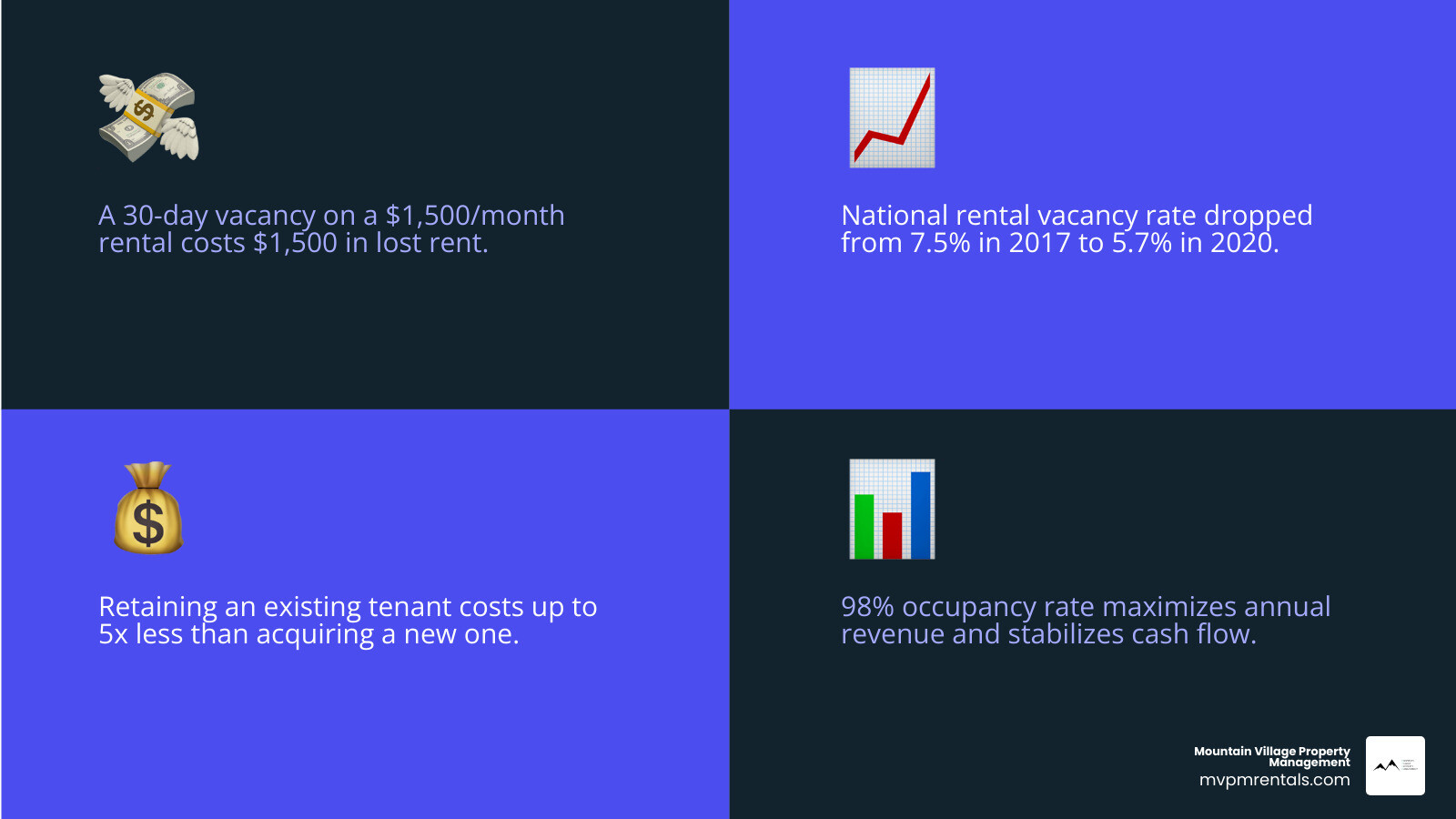
Every day a unit sits empty, you’re losing money. A single 30-day vacancy on a $1,500/month rental means $1,500 gone — plus the cost of advertising, screening, and turnover prep on top of that.
It adds up fast.
And yet, most vacancy problems are preventable. The national rental vacancy rate dropped from 7.5% in 2017 to 5.7% in 2020, showing that strong management practices genuinely move the needle. At the same time, retaining an existing tenant costs up to five times less than finding a new one — which means the best defense against vacancy is keeping the tenants you already have.
This guide covers exactly how to do that.
I’m Pablo Negrete, co-owner of Mountain Village Property Management (MVPM) in Bozeman, Montana — where we maintain a 98% occupancy rate across our portfolio of single-family homes and multi-unit rentals. Over the years, hands-on experience in Southwest Montana’s competitive rental market has shown me precisely how property managers ensure high occupancy rates, and I’ll walk you through every strategy we rely on.
Understanding the Math: What is Occupancy Rate and Why It Matters
In property management, the occupancy rate is the heartbeat of your investment. Simply put, it is the percentage of available units that are currently rented out. We calculate this by taking the number of occupied units, dividing it by the total number of units in the portfolio, and multiplying by 100. For example, if you own a 10-unit complex in Belgrade and 9 are filled, you have a 90% occupancy rate.

While 100% occupancy is the “holy grail,” seasoned managers often look for an “optimum” rate. Why? Because 100% occupancy might actually mean your rents are too low. However, staying well above the national average is critical. According to Rental vacancy rates in the US, rates have fluctuated significantly, dropping to as low as 5.7% in recent years before seeing slight upticks. In high-demand areas like ours, Bozeman Montana Property Management requires a sharp eye on these metrics to ensure landlords aren’t leaving money on the table.
The Critical Link Between Occupancy and ROI
High occupancy isn’t just a vanity metric; it is the primary driver of your Return on Investment (ROI). When units are full, your cash flow is predictable. This stability allows us to maintain better expense ratios—spreading the fixed costs of taxes, insurance, and landscaping across more paying tenants.
Furthermore, a property with a proven track record of high occupancy is worth more. Appraisers and future buyers look at “stabilized” income. If your property in Livingston or Big Sky shows consistent 95%+ occupancy, it builds stakeholder trust and increases the overall market value of the asset. Vacancy is “bleeding” cash; high occupancy is the bandage that keeps your investment healthy.
Strategic Pricing and Marketing: How Property Managers Ensure High Occupancy Rates
You can have the most beautiful Victorian home in Butte or a modern condo in Gallatin Gateway, but if no one knows it’s for rent—or if it’s priced like a penthouse in Manhattan, NY—it will sit empty. Professional how property managers ensure high occupancy rates starts with a sophisticated approach to the “Top of the Funnel”: getting eyes on the property and pricing it to move.
We don’t guess on rent. We use “rental comps”—comparing your property to similar ones nearby that have recently leased. We look at square footage, amenities, and even the “feel” of the neighborhood. Research shows that listings with high-quality visuals perform significantly better; in fact, 35% of tenants prefer virtual tours over traditional showings, and listings featuring them can see a 50% increase in views.
Market Analysis: How Property Managers Ensure High Occupancy Rates in Competitive Markets
In competitive markets like Bozeman and Belgrade, timing is everything. We analyze seasonal demand—knowing that the rental market peaks in late spring and summer as people move for jobs or school. By using tools like the Zillow Zestimate and our own internal database of 110M units’ worth of data insights, we can benchmark your property against the competition in real-time.
Demographic targeting is also key. A student at Montana State University has different needs than a professional working remotely in Three Forks. We tailor our marketing language to highlight what matters most to the likely tenant, whether that’s high-speed internet for the “Zoom towns” or proximity to campus for the student crowd.
Leveraging Technology: How Property Managers Ensure High Occupancy Rates Through Software
Modern property management is no longer about “Post-it” notes and spreadsheets. We utilize advanced systems like the Delta Property Management System to streamline the entire leasing process.
Software allows us to:
- Track Leads: We know exactly where your tenants are coming from (Facebook, Zillow, or our own site).
- Automate Follow-ups: If a prospect inquires at 2:00 AM, they get an immediate response.
- Virtual Walkthroughs: We can “show” a property in Manhattan, MT to someone currently living in Florida, securing a lease before they even land at the airport.
The Power of Retention: Keeping Tenants Long-Term
The most expensive tenant you will ever have is a new one. Between the cleaning costs, the advertising spend, and the potential for a “void period” where no rent is coming in, the costs stack up. That’s why how property managers ensure high occupancy rates is largely a game of retention.
| Metric | New Tenant Acquisition | Existing Tenant Retention |
|---|---|---|
| Relative Cost | 5x more expensive | 1x (Baseline) |
| Probability of Success | 15-20% | 70% |
| Time Investment | High (Showings, Screening) | Low (Renewal Lease) |
As the data shows, retaining existing tenants is 70% more likely than finding new ones. At MVPM, we treat our tenants like the valued customers they are.
Communication and Community Building
Poor communication is the #1 reason tenants leave. If a tenant in Big Sky has a leaky faucet and doesn’t hear back for three days, they start looking at other apartments. We maintain an “open-door” policy and use digital portals to ensure feedback loops are closed quickly.
Building a sense of community also helps. Whether it’s a simple holiday card or a well-maintained common area in a multi-unit complex, making a house feel like a “home” creates an emotional bond that makes moving much less attractive. Professionalism in every interaction—from the way we dress to the accuracy of our billing—builds the trust necessary for long-term stays.
Lease Renewal Incentives and Strategies
Sometimes, a small gesture goes a long way. We’ve found that 50% of males and 41% of females stay longer with rent discounts or small upgrades.
When a lease is coming up for renewal, we don’t just send a bill. We might offer:
- Property Upgrades: “If you renew for 12 months, we’ll install that new smart thermostat you wanted.”
- Referral Bonuses: Offering a credit if they help us fill a neighboring unit.
- Early-Bird Discounts: Waiving a small portion of the first month’s new rent if they sign the renewal 60 days in advance.
Operational Excellence: Maintenance and Screening
You can’t keep a property occupied if it’s falling apart or if the neighbors are a nightmare. Operational excellence is the foundation of how property managers ensure high occupancy rates. This involves two main pillars: who you let in, and how you take care of the building.
At Mountain Village Property Management, our Property Management services are designed to catch problems before they become catastrophes.
Thorough Tenant Screening for Sustained Occupancy
A “bad” tenant is worse than a vacancy. Evictions can take months and cost thousands in legal fees and lost rent. That’s why our screening process is rigorous. We look at:
- Credit History: Does the applicant have a history of paying their bills on time?
- Criminal Background: Ensuring the safety of the community.
- Employment Verification: Can they actually afford the rent (typically requiring 3x the rent in monthly income)?
- Frequent Movers: We look for “rental hoppers.” Tenants who move every 6 months are a red flag for occupancy stability.
Proactive Maintenance and Property Upgrades
Tenants in Bozeman and Belgrade expect quality. If a property has “curb appeal,” it attracts a higher caliber of tenant who is more likely to take care of the home.
We aim for a 48-hour response time on non-emergency repairs. Research shows that resolving maintenance issues within this window can increase tenant retention by 15-20%. We also recommend energy-efficient upgrades. Not only do energy-efficient systems reduce costs by up to 70% for whoever is paying the utilities, but they are also a major selling point for the modern, eco-conscious Montana renter.
Frequently Asked Questions about High Occupancy Rates
What is a healthy occupancy rate for rental properties?
In the Southwest Montana market, we consider anything above 92% to be healthy. While 100% is great for the short term, a small amount of “healthy turnover” allows us to perform deep cleans and adjust rents to current market rates, ensuring the property remains profitable.
How do property managers handle seasonal fluctuations in college towns like Bozeman?
College towns have a specific rhythm. We align lease end-dates with the academic calendar (May or August) to ensure that when a unit does become vacant, it hits the market exactly when thousands of students and faculty are looking for a place to live.
What are the most common mistakes that lead to high vacancy?
The “Big Three” are overpricing, poor communication, and deferred maintenance. If a landlord refuses to fix an aging HVAC system or insists on charging $500 over market value, the property will sit. Additionally, failing to respond to leads quickly is a huge mistake; an average renter visits 19 properties before deciding, so if you don’t answer the phone, they’ve already moved on to the next one.
Conclusion
Maximizing your rental income doesn’t have to be a guessing game. By focusing on data-driven pricing, rigorous screening, and a “tenant-first” retention strategy, you can stop the bleeding of vacancy loss and enjoy the stability of a high-performing asset.
At Mountain Village Property Management, we pride ourselves on being the local experts in Bozeman, Belgrade, Big Sky, and the surrounding areas. We offer a full-service, hassle-free experience with a transparent 4.9%–8.9% management fee and no set-up fee (Signature & Summit plans). Our goal is simple: to treat your investment as if it were our own.
Ready to see how we can boost your occupancy?
- Call us: 406-602-2018
- Email us: admin@mvpmrentals.com
- Visit us: Maximize your rental income today
Let us help you turn your rental into a high-occupancy success story.