
Why Rental Property Financial Management is the Foundation of Real Estate Success
Rental property financial management is the systematic process of tracking income, managing expenses, budgeting for the unexpected, and optimizing taxes to maximize the profitability of your rental investments. Here’s what successful landlords focus on:
- Separate dedicated bank accounts for rental income and expenses
- Track every dollar – all rent, fees, repairs, and operating costs
- Build a reserve fund of 3-6 months operating expenses
- Understand the difference between operating expenses (deductible) and capital expenses (depreciated)
- Calculate key metrics like cash flow, NOI, and cash-on-cash return
- Maintain meticulous records with receipts and documentation for taxes
- Prepare for tax season using Schedule E and maximizing deductions
Whether you have one rental property or ten, sound financial management is what separates profitable investments from money pits. It’s not just about collecting rent checks—it’s about creating systems that protect your investment, minimize risk, and set you up for long-term wealth building.
As one experienced landlord puts it: “Whether you have one rental property or a few, self-manage or have a property manager, at the heart of every successful rental venture is effectively managing the finances for your property.”
The stakes are real. Poor financial management can lead to cash flow problems, missed tax deductions, legal compliance issues, and ultimately, financial losses that eat away at your returns. On the flip side, disciplined financial practices can help you maximize deductions, forecast expenses, make data-driven decisions about rent pricing, and know exactly when it’s time to scale your portfolio.
For Bozeman-area property owners, the financial landscape comes with unique considerations—seasonal vacancy patterns, weather-related maintenance costs like snow removal and heating, and a competitive rental market that demands strategic pricing. Understanding your numbers isn’t optional; it’s the foundation of sustainable success.
I’m Pablo Negrete, co-owner of Mountain Village Property Management, where we’ve maintained a 98% occupancy rate across Southwest Montana by combining responsive service with rigorous rental property financial management practices. Over the years of managing single-family homes and multi-unit properties in Bozeman, Belgrade, Big Sky, and Livingston, I’ve seen how proper financial systems separate thriving investments from struggling ones.
Foundations: Setting Up Your Financial Framework
Effective rental property financial management begins long before you collect your first rent check. It starts with building a robust financial framework that separates your personal finances from your investment, ensuring clarity, compliance, and protection.
A critical first step, especially if it is your first time out of the gate as a landlord, is to set up at least two additional banking accounts that are to be used solely for your rental property. This clear separation of personal and business funds is paramount. Not only does it make investment decisions, tax filing, and performance monitoring significantly easier, but it also provides a crucial layer of asset protection. If you operate your rental properties under a business structure like an LLC, commingling funds can “pierce your corporate veil,” eliminating the very protection you sought.
Beyond a dedicated checking account for income and expenses, we highly recommend a separate savings account for security deposits. Many state landlord/tenant laws, including those in Montana, require tenant security deposits to be held in a separate, dedicated account. This ensures compliance and prevents accidental spending, safeguarding funds that legally belong to your tenants until their lease concludes.
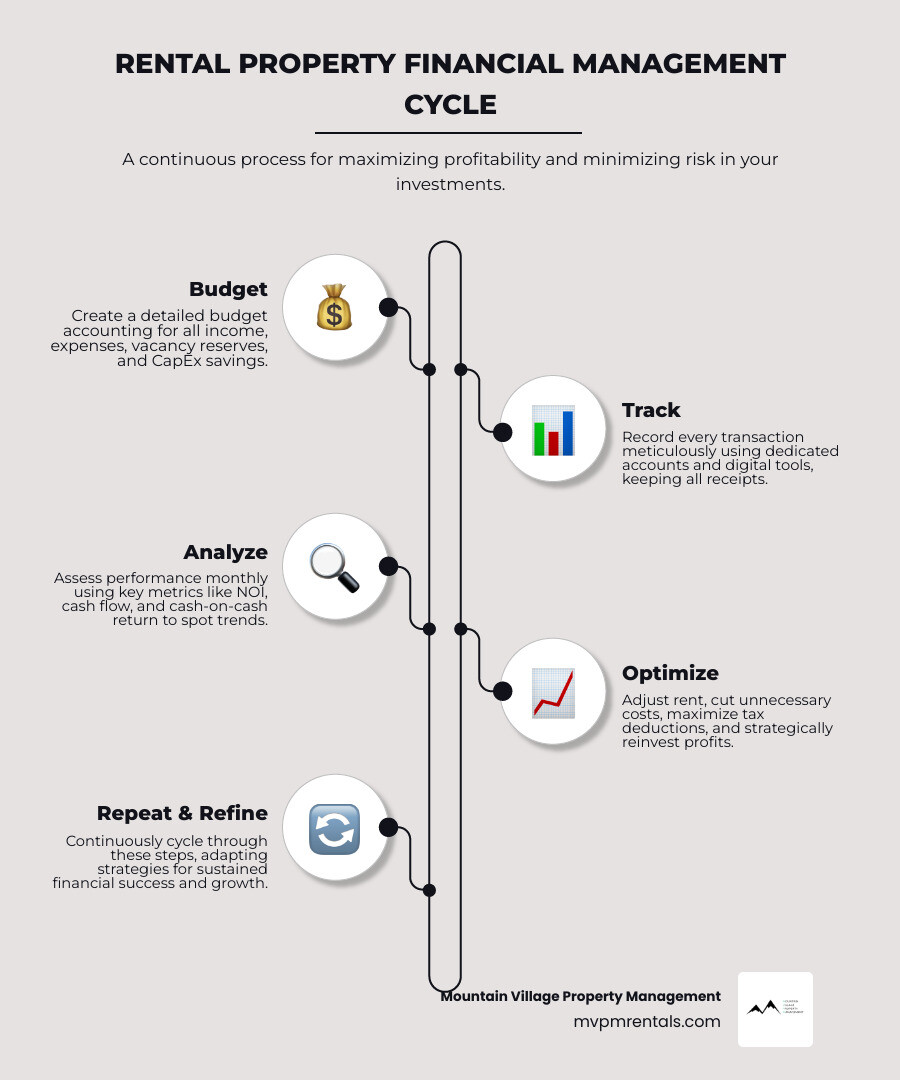
Once your accounts are established, the next foundational element is a detailed budget. This is your financial roadmap, outlining both fixed and variable expenses, from mortgage payments to landscaping costs. A comprehensive budget should also factor in a realistic vacancy rate, typically 5-10%, and set aside money for unforeseen expenses like repairs or legal fees. As we often tell our clients, being a landlord does mean taking on a certain measure of risk, and a robust budget helps mitigate that risk.
Setting Up for Success: Your Rental Property Financial Management Toolkit
To effectively manage your rental property’s finances, you’ll need more than just good intentions. Here’s your essential toolkit:
- Dedicated Checking Account: For all incoming rent payments and outgoing operating expenses. This is your primary hub for daily transactions.
- Dedicated Savings Account: Crucial for holding tenant security deposits, ensuring compliance with Montana’s landlord-tenant laws.
- Emergency Reserve Fund: This isn’t just for repairs. It’s your cash cushion for unexpected vacancies, legal fees, or major capital expenditures. Experts recommend setting aside at least three to six months’ worth of operating expenses, including mortgage, taxes, insurance, and basic maintenance. We’ve seen in areas like Butte and Gallatin Gateway how critical this fund can be.
- Budgeting for Repairs: A good rule of thumb is to set aside at least ten percent of your gross rental income in savings to eventually use for repairs. Some landlords aim to have at least six months’ worth of mortgage payments set aside for repairs and as a cash cushion.

Creating a Bulletproof Budget for Your Bozeman Rental
A detailed budget is the bedrock of successful rental property financial management. For properties in Bozeman, Belgrade, Livingston, or any of our other Montana locations, your budget should include:
- Mortgage Payments: Principal and interest, if applicable.
- Property Taxes: These vary significantly by location within Montana.
- Insurance: Landlord insurance is essential, often different from standard homeowner’s insurance.
- HOA Fees: If your property is part of a homeowners’ association.
- Utilities: Any utilities you cover as the landlord (e.g., water, sewer, trash).
- Landscaping & Snow Removal: Especially critical in our Montana winters!
- Vacancy Loss: Factor in a realistic buffer of 5% to 10% vacancy in your gross rental income projection. Even with high occupancy rates like ours, it’s smart to plan for the unexpected.
- Capital Expenditures (CapEx) Savings: Funds for major replacements like roofs, furnaces, or appliances. We’ll dive into this more later.
By carefully planning for these costs, you gain a clear picture of your property’s financial health and are prepared for the ebb and flow of the rental market.
The Core of Rental Property Financial Management: Tracking Every Dollar
Once your financial framework is in place, the daily grind of rental property financial management revolves around meticulous record-keeping. We cannot stress enough the importance of tracking every single dollar that flows in and out of your rental business. This isn’t just about knowing where your money goes; it’s about making informed decisions, optimizing profitability, and staying compliant with tax regulations.
The IRS is clear: you generally must have documentary evidence, such as receipts, canceled checks or bills, to support your expenses. Whether you choose the cash method (reporting income when received and expenses when paid) or the accrual method (reporting income when earned and expenses when incurred), consistency and detailed documentation are key. For most individual landlords, the cash method is simpler and more common.
Tracking Rental Income and Expenses
Accurate tracking of both income and expenses is paramount. What exactly should you be tracking?
Income Sources:
- Gross Rent: The regular monthly rent payments.
- Late Fees: Charges for overdue rent.
- Pet Fees: Non-refundable fees or monthly pet rent.
- Parking Fees: If you charge for dedicated parking spaces.
- Utility Reimbursements: If tenants reimburse you for utilities you initially pay.
- Application Fees: For tenant screening.
- Lease Breakage Fees: Payments for early lease termination.
- Security Deposits: These are generally not considered income until they are forfeited.
Common Deductible Operating Expenses:
- Mortgage Interest: Often the largest deduction.
- Property Taxes: Paid to the local government.
- Insurance Premiums: Landlord insurance, liability insurance.
- Maintenance Costs: Routine repairs (e.g., leaky faucet, lawn care, painting between tenants).
- Professional Fees: Property management fees, legal fees, accounting services.
- Advertising: Costs to market your vacant property.
- Utilities: Any utilities you pay as the landlord.
- Travel Expenses: For property visits, repairs, or inspections.
- Supplies: Cleaning supplies, light bulbs, etc.
- HOA Fees: If applicable.

Operating Expenses vs. Capital Expenses
Understanding the difference between operating expenses and capital expenses is crucial for both your budget and your tax strategy. The IRS treats these very differently:
| Feature | Operating Expenses (Repairs) | Capital Expenses (Improvements) |
|---|---|---|
| Definition | Ordinary and necessary expenses for managing, conserving, and maintaining your rental property to keep it in good operating condition. They do not add to the property’s value or prolong its useful life. | Costs that add to the value of your property, prolong its useful life, or adapt it to new uses. A Capital Expense is a repair that “has a useful life”, so its cost is deducted over a number of years. |
| Tax Treatment | Fully deductible in the year they are incurred. | Not immediately deductible. Instead, their cost is recovered over a number of years through depreciation. |
| Examples | Patching a hole in drywall, fixing a leaky faucet, repainting a room (if not part of a larger renovation), routine cleaning, replacing a broken window pane, fixing a broken appliance, lawn care, pest control, unclogging a toilet. | Adding a new room, replacing an entire roof, installing new flooring throughout the property, upgrading to energy-efficient windows, replacing an entire HVAC system, adding a new fence, paving a driveway, adding a new appliance (e.g., dishwasher where there wasn’t one), substantial renovation that brings the property to a higher standard. |
| Goal | To maintain the property’s current condition. | To improve, restore, or adapt the property. |
Mistaking one for the other can lead to errors on your tax return and potentially missed deductions or complications during an audit. This distinction is especially important for properties in areas like Big Sky, where properties often undergo significant upgrades.
Streamlining Your Rental Property Financial Management with Technology
The good news is that managing these financial intricacies doesn’t have to be a mountain of paperwork. Technology offers powerful solutions to streamline your rental property financial management. We encourage all landlords to accept digital tools:
- Digital Rent Collection: Online payment platforms simplify rent collection, reduce late payments, and provide clear records. Many renters prefer to pay online, making this a win-win.
- Expense Tracking Tools: Property management software or dedicated accounting apps allow you to categorize expenses, attach digital receipts, and generate reports with ease. This can save you hours during tax season.
- Digital Document Storage: Cloud-based systems (like Google Drive) ensure all your financial documents—leases, invoices, receipts, tax forms—are securely stored and accessible from anywhere. This is particularly useful for owners managing properties in Montana from a distance.
- Financial Reporting Dashboards: Many modern solutions provide real-time insights into your property’s performance, allowing you to quickly spot trends, identify areas for improvement, and make data-driven decisions.
While spreadsheets can work for small portfolios, as your investment grows, dedicated property management software becomes invaluable. For landlords seeking a streamlined, professional approach, Mountain Village Property Management offers comprehensive financial management as part of our services, leveraging advanced tools to ensure accuracy and efficiency.
Optimizing for Profitability and Taxes
Tracking every dollar is just the beginning. The real magic in rental property financial management happens when you use that data to optimize your profitability and minimize your tax burden. This involves consistently evaluating your property’s financial health, understanding complex tax rules, and making informed decisions.
Key Metrics to Measure Financial Performance
To truly understand how well your rental property is performing, you need to look beyond just the rent collected. We rely on several key metrics:
- Net Operating Income (NOI): This is your property’s income after all operating expenses (but before mortgage payments and taxes). It’s a great indicator of a property’s operational efficiency.
- Cash Flow: This is the money left over after all expenses, including your mortgage payment, have been paid. Positive cash flow is essential for liquidity and covering unexpected costs.
- Cash-on-Cash Return: This metric calculates the annual pre-tax cash flow relative to the total cash invested. Many investors aim for at least an 8–10% cash-on-cash return on long-term rentals.
- Capitalization (Cap) Rate: This is the ratio of NOI to the property’s purchase price or current market value. It helps compare the relative value of different investment opportunities. Most investors advise to aim for a cap rate between 5-10%.
- Gross Rent Multiplier (GRM): A quick way to compare properties by relating the property’s price to its gross annual rental income.
Tip: Use online calculators or consult with your property manager for accurate analysis. These metrics are vital for assessing properties in diverse markets like Three Forks or Manhattan.
Understanding Depreciation and Tax Deductions
One of the biggest perks of real estate investing, often called the “silent partner,” is depreciation. The IRS allows rental property owners to take a depreciation allowance, which in turn reduces your overall taxable income. This non-cash deduction accounts for the wear and tear on your property over time. For residential rental property, the IRS typically allows you to depreciate the value of the building (not the land) over 27.5 years.
For properties placed into service after 1986, the IRS requires using the Modified Accelerated Cost Recovery System (MACRS) for depreciation. This can significantly lower your taxable income, even if your property is cash-flow positive.
Beyond depreciation, remember to maximize your tax deductions. These include all your ordinary and necessary operating expenses, such as mortgage interest, property taxes, insurance, maintenance, property management fees, and even travel to and from your rental property for repairs or inspections. Many landlords report their rental income and expenses on Form 1040 or 1040-SR, Schedule E, Part I.
To ensure you maximize your tax deductions and steer the complexities of tax law, we highly recommend working with a qualified tax professional or your property management team. They can help you identify all eligible deductions and ensure compliance.
Avoiding Pitfalls and Knowing When to Scale
Even with a solid financial framework, landlords can encounter common pitfalls that derail their investments. A key part of successful rental property financial management is knowing what to look out for and when to seek professional assistance.
Common Financial Blunders Landlords Make
We’ve seen landlords make these mistakes time and again, and they can be costly:
- Commingling Funds: As mentioned earlier, mixing personal and business accounts is a recipe for disaster, complicating taxes and potentially voiding liability protection.
- Underestimating Expenses: Especially Capital Expenditures (CapEx). Many landlords focus only on monthly operating costs and forget to budget for major replacements like a new roof or furnace.
- Inaccurate Record-Keeping: This leads to missed deductions, audit risks, and an unclear picture of profitability.
- DIY Tax Filing Errors: Tax laws for rental properties are complex; attempting to steer them without professional help can lead to costly mistakes.
- Neglecting Property Maintenance: Skimping on maintenance can lead to larger, more expensive repairs down the line, tenant dissatisfaction, and higher turnover.
- Poor Tenant Screening: Placing unreliable tenants can lead to costly evictions, property damage, and lost rent, directly impacting your cash flow. This also impacts tenant turnover, as quality tenants are more likely to stay. You can find more info about our tenant services and our rigorous screening process.
When to Hire a Property Manager
As your portfolio grows or your life gets busier, the administrative burden of rental property financial management can become overwhelming. This is often when landlords consider hiring a property manager. Rental property management is the practice by which a third party is responsible for maintaining a residence’s status quo and appeasing its occupants.
Consider professional property management if you:
- Own Multiple Properties: Juggling multiple leases, maintenance requests, and financial records for properties in Bozeman, Butte, or Manhattan can be a full-time job.
- Are a Long-Distance Investor: Managing a property in Livingston while living elsewhere is challenging. A local manager provides boots on the ground.
- Lack Time or Expertise: If you’re stretched thin or simply don’t enjoy the day-to-day tasks of landlording.
- Desire Passive Income: A property manager handles the heavy lifting, allowing you to enjoy the returns without the headaches.
- Are Overwhelmed by Administrative Tasks: From rent collection to expense tracking and tax preparation, a manager can streamline these processes.
Property management fees typically range from 8-12% of collected rent. For many, the value a good property manager provides—expert tenant screening, efficient maintenance coordination, robust financial reporting, and legal compliance—far outweighs the cost. At Mountain Village Property Management, we pride ourselves on our transparent 4.9%–8.9% management fee, no set-up fee (Signature & Summit plans), and high occupancy rates, maximizing your rental income while providing peace of mind. For more info about our services, we invite you to explore our offerings.
Frequently Asked Questions about Rental Property Finances
How much should I save for unexpected repairs?
A good rule of thumb is to set aside 1-3% of the property’s value annually, or at least 10% of your gross rental income. Many experienced landlords, especially in areas with harsh winters like Big Sky, aim to have a cash cushion equal to six months’ worth of mortgage payments. This fund helps cover everything from a sudden furnace replacement to a roof repair after a heavy snowstorm, ensuring you’re prepared for the inevitable.
What is the difference between cash flow and profit?
Cash flow is the net amount of cash moving in and out of your rental business, including mortgage principal payments. It’s about liquidity—do you have enough money coming in to cover your outgoing payments? Profit (or Net Income) is your total income minus all your expenses, including non-cash expenses like depreciation, but it doesn’t subtract principal loan payments. While both are crucial, positive cash flow is essential for day-to-day operations and avoiding financial distress, while profit measures overall financial success and long-term wealth creation.
Can I manage my rental property finances with just a spreadsheet?
Yes, especially for one or two properties, a well-organized spreadsheet can effectively track income and expenses. However, as your portfolio grows, or if you prefer to spend your time on other pursuits, working with a professional property management company like Mountain Village Property Management can save significant time, reduce errors, and provide more powerful reporting and automation features. We bring expertise in navigating the local market specifics of Bozeman, Belgrade, and surrounding areas, ensuring your financial management is both efficient and optimized.
Conclusion
Effective rental property financial management is not merely a task; it’s a strategic imperative for any successful landlord. By establishing a solid financial framework, carefully tracking every dollar, and optimizing for profitability and taxes, you transform your rental properties into well-oiled wealth-building machines.
We’ve covered the essential components, from setting up dedicated bank accounts and creating a detailed budget to understanding the nuances of operating versus capital expenses, and leveraging technology to streamline your processes. We’ve also highlighted the critical financial metrics that truly measure your property’s health and the invaluable role of depreciation in your tax strategy.
Common financial blunders can quickly erode your returns, and knowing when to scale your operations or engage a professional property manager is a sign of smart investing. The financial discipline you apply today directly impacts your long-term success and peace of mind tomorrow.
For landlords in Bozeman, Belgrade, Butte, Livingston, Big Sky, Gallatin Gateway, Three Forks, and Manhattan, Montana, seeking to optimize their portfolio’s financial performance and achieve true peace of mind, professional management is the smartest investment. At Mountain Village Property Management, we combine our expertise with a transparent 4.9%–8.9% management fee, no set-up fee (Signature & Summit plans), and high occupancy rates to ensure your rental property financial management is not just compliant, but truly maximizes your ROI. Learn more about our full-service property management solutions and let us help you achieve your financial goals.