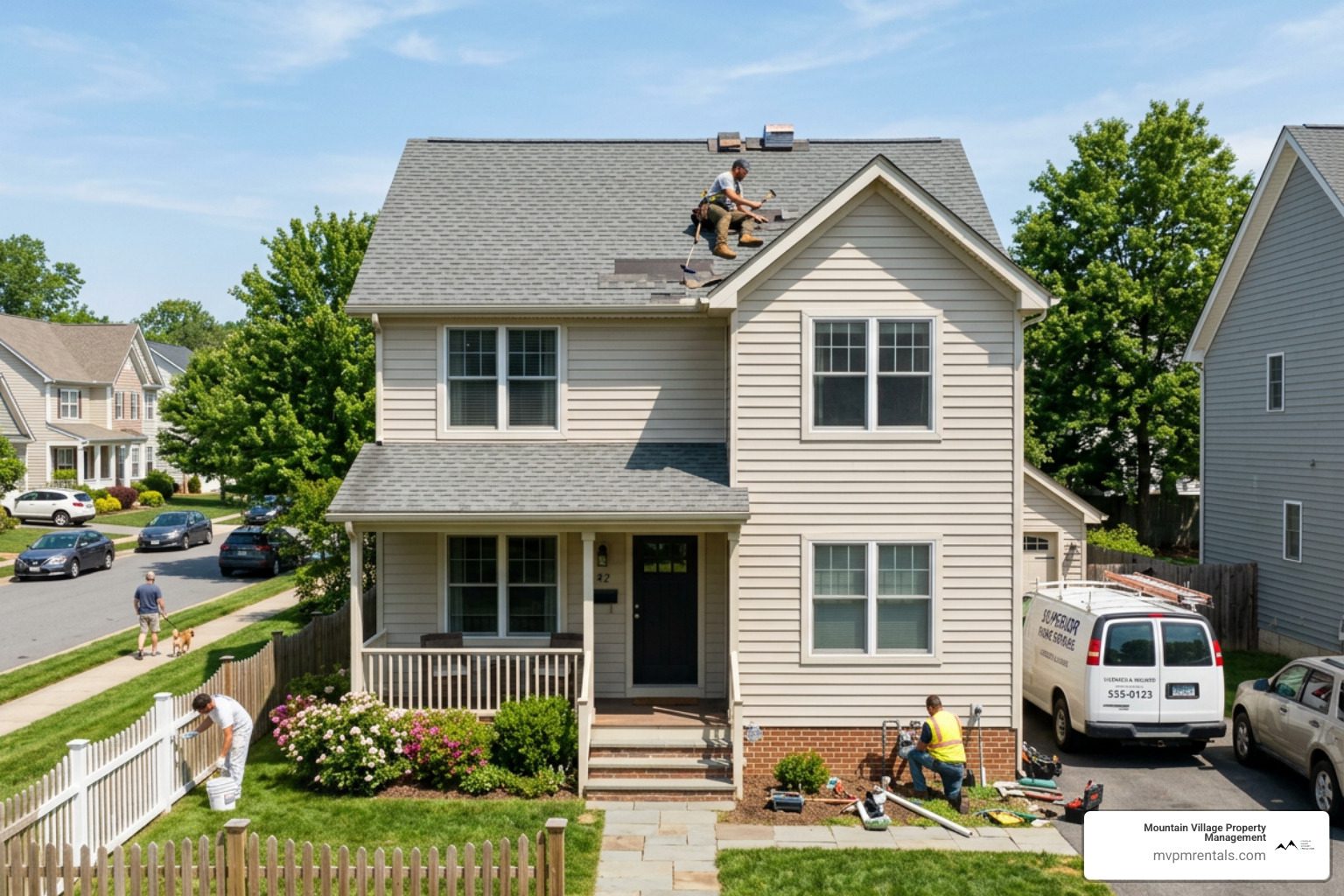
What Are Typical Maintenance Costs for a Rental Property?
Typical maintenance costs rental property owners face generally fall between 1% and 2% of the property’s value per year — but the real number depends on your property’s age, size, location, and tenants.
Here’s a quick snapshot of the most widely used budgeting benchmarks:
| Rule | Formula | Example |
|---|---|---|
| 1% Rule | 1% of property value/year | $5,000/year on a $500,000 home |
| Square Footage Rule | $0.90–$1.30 per sq ft/year | $1,620–$2,340 for 1,800 sq ft |
| Rent Multiplier | 4–6x one month’s rent/year | $12,000–$18,000 at $3,000/mo rent |
| 50% Expense Ratio | 50% of gross rent for all operating costs | $18,000/year on $3,000/mo rent |
In practice, most landlords spend somewhere in the $0.90 to $1.30 per square foot range annually, based on data from thousands of real work orders. And here’s the part that stings: 76% of landlords report that yearly maintenance costs come in higher than expected.
Whether you own one rental home in Bozeman or a growing portfolio across Southwest Montana, knowing what’s coming — and planning for it — is the difference between steady cash flow and a financial headache.
I’m Pablo Negrete, co-owner of Mountain Village Property Management, and I’ve spent years managing single-family homes and multi-unit rentals throughout the Bozeman area, giving me a front-row seat to the typical maintenance costs rental property owners here actually face. In this guide, I’ll walk you through the real numbers, the rules that work, and the strategies that keep your budget intact.
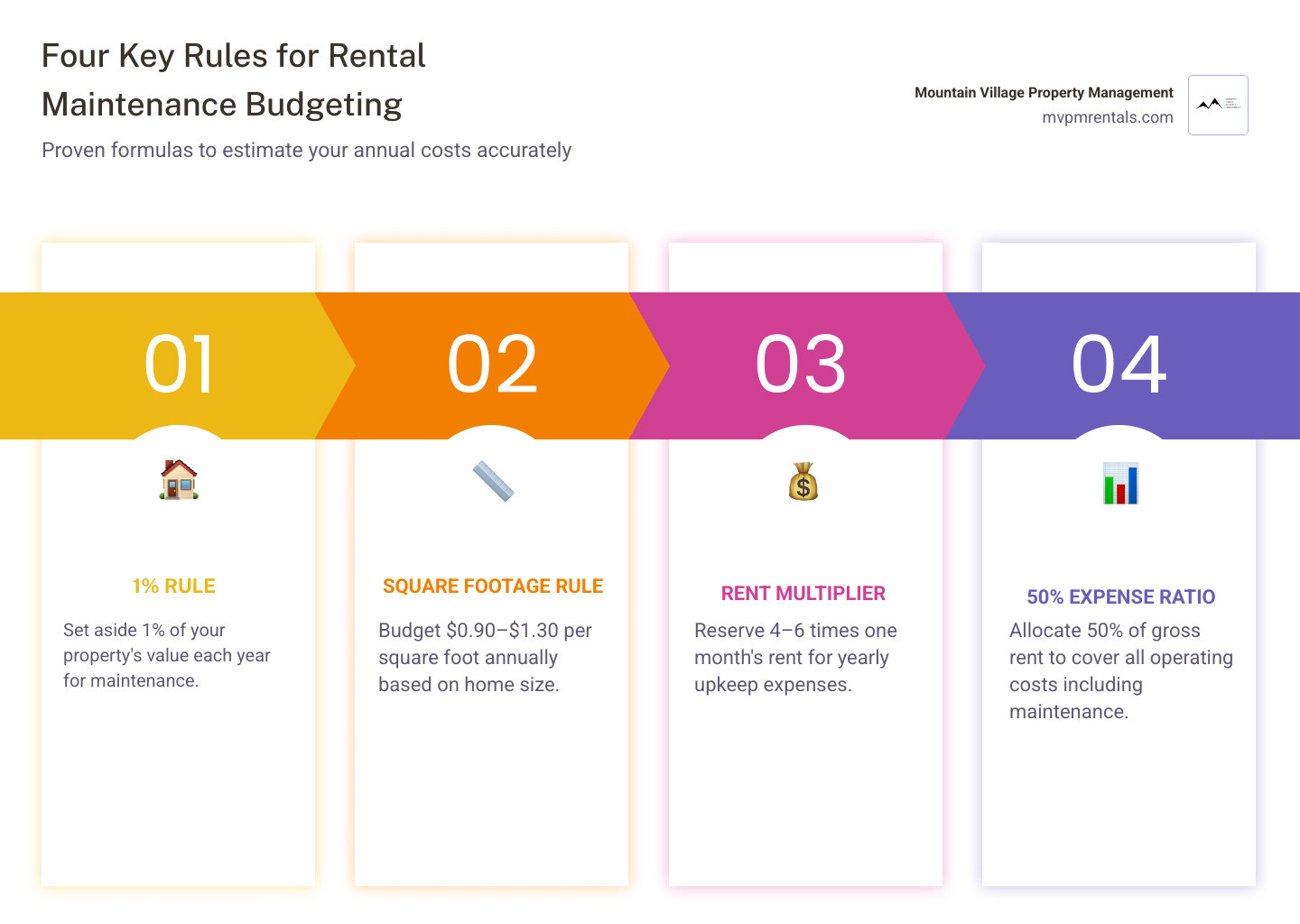
Typical maintenance costs rental property terms explained:
The Golden Rules: Estimating Typical Maintenance Costs Rental Property
When you first dive into real estate investing in places like Belgrade or Manhattan, MT, the math seems simple. Rent minus mortgage equals profit, right? If only! The silent “cash flow killer” is maintenance. To prevent your bank account from bleeding out, we use a few “Golden Rules” to forecast typical maintenance costs rental property owners will encounter.
While these rules aren’t magic crystal balls, they provide a necessary baseline. Relying on “gut feeling” is a great way to end up broke when a furnace dies in the middle of a Big Sky January.
| Rule | Description | Best For |
|---|---|---|
| 1% Rule | Set aside 1% of the property’s total purchase price annually. | Quick estimates during the buying phase. |
| Square Footage Rule | Budget $1.00 per square foot of living space per year. | Properties where value is inflated by location but size is modest. |
| 5X Rent Multiplier | Save 4 to 6 times one month’s rent for annual upkeep. | High-rent areas where 1% of value might be overkill. |
| 50% Rule | Total operating expenses (maintenance, taxes, insurance) will take 50% of gross rent. | Comprehensive long-term wealth planning. |
Looking at 2025 cost projections, we are seeing a shift. National labor shortages and rising material costs mean that the old “$1 per square foot” rule is evolving. Modern data suggests a range of $0.90 to $1.30 per square foot, depending heavily on the age of the home. If you are managing an older Victorian in Butte, you’ll likely be on the higher end of that scale compared to a brand-new build in Gallatin Gateway.
Understanding your operating expense ratio is vital. If you aren’t tracking every dollar, you aren’t running a business; you’re hosting an expensive hobby. More info about property management services can help you get these systems in place so you can focus on growth rather than leaky faucets.
Understanding the 1% Rule vs. Real-World Data
The 1% Rule is the most famous benchmark in the industry. If you buy a beautiful home in Bozeman for $500,000, you should theoretically tuck away $5,000 a year for repairs. It’s a great “quick compass,” but real-world data from companies like Belong shows that actual spending is more nuanced.
For example, their median spend data sits at roughly $0.90 per square foot. On a 2,000-square-foot home, that’s $1,800. Why the gap? Because the 1% rule often accounts for “lumpy” expenses—those big hits like a new roof—while the square footage data often reflects the day-to-day “median” reality. We recommend using a hybrid approach: budget the median for the “now” and keep the 1% reserve for the “eventually.”
Why the 50% Rule Matters for Long-Term Wealth
If you want to build long-term wealth, you have to look at the “50% Rule.” This rule suggests that half of your gross rental income will disappear into operating expenses—taxes, insurance, vacancy, and maintenance—before you even touch the mortgage.
While 50% sounds high (and we often aim to keep it lower for our clients through efficient management), it’s a safe way to ensure you never have to pay the property’s bills out of your own pocket. To see how this fits into your specific portfolio, you should learn how to do an accurate rental property cash flow analysis. This prevents the “surprise” of a low-profit year.
Breaking Down the Numbers: What Landlords Actually Spend
It’s one thing to talk about percentages; it’s another to write the check. In our experience across Montana, about 32% of all repair costs are tied to emergency maintenance. These are the “it’s 2:00 AM and the pipe burst” calls. Emergencies are always more expensive because you’re paying for speed and after-hours labor.
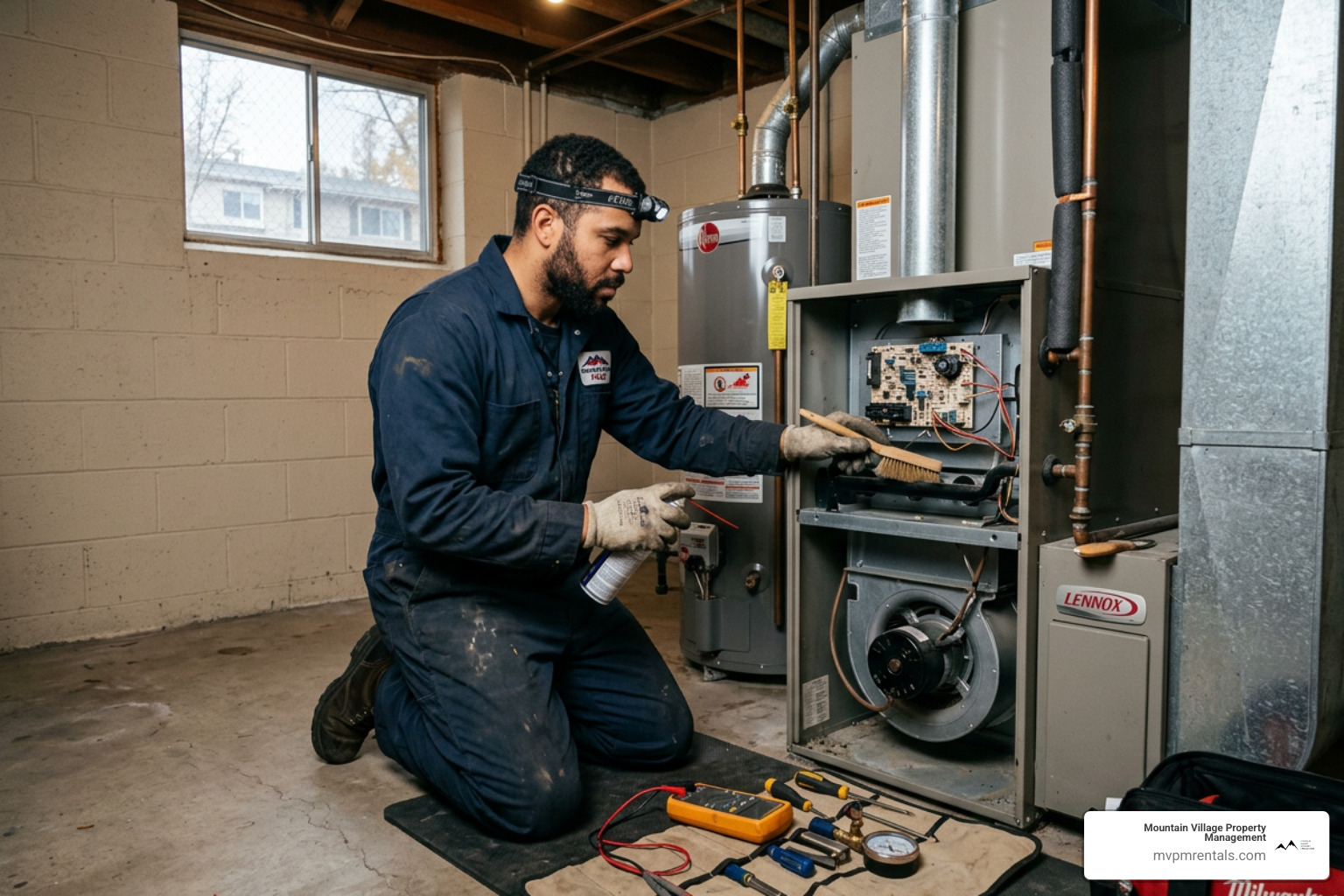
When we look at typical maintenance costs rental property owners face, labor is the biggest variable. General maintenance labor usually starts around $85/hr. If you need a specialist like an electrician or a licensed plumber, expect that to jump to $100-$150/hr.
One cost that catches many new landlords off guard is the “turnover cost.” Every time a tenant moves out, you should re-key the property for security. A professional re-key for a standard home usually runs around $300. It’s a non-negotiable for liability reasons. For a full list of what to expect, check out these 16 rental property maintenance expenses landlords can expect.
Common Repair Costs for Your Rental Property
Let’s get granular. Based on current 2025 market rates in the Bozeman and Belgrade areas, here are the “usual suspects” you’ll see on your ledger:
- HVAC Servicing: A standard tune-up costs between $150 and $300. Doing this twice a year can save you from an $8,000 replacement bill.
- Garbage Disposals: These are the natural enemies of tenants. A repair is usually $200, but a full replacement with labor sits around $375.
- Drain Cleaning: Clogged lines are common. A standard augering or clearing service typically costs $125 to $250.
- Safety Equipment: Smoke and CO2 detector replacements are required by law. Budget about $95 per unit for high-quality, 10-year sealed battery models.
- Pest Control: A standard preventative treatment for a single-family home is roughly $150 per visit.
Exterior and Seasonal Upkeep Costs
In Montana, the exterior of your property takes a beating. From the heavy snow loads in Big Sky to the summer heat in Three Forks, seasonal upkeep is mandatory.
- Landscaping: Basic mowing and weed control run $50 to $200 monthly.
- Gutter Cleaning: Essential to prevent ice dams. Expect to pay $120 per service.
- Roof Repairs: Catching a small leak early might cost $300. Ignoring it until the ceiling collapses? You’re looking at thousands.
- Snow Removal: This is the big one for us. Depending on the size of the driveway and the frequency of storms, snow removal can be a significant monthly line item in the winter.
For more localized tips on handling the unique Montana elements, see our Bozeman Montana Property Management advice.
Maintenance vs. Capital Expenditures (CapEx)
One of the biggest mistakes we see landlords make is confusing “repairs” with “CapEx.” This distinction is huge for your taxes and your long-term planning.
According to the IRS, maintenance consists of the costs to keep your property in good working condition (fixing a leak, painting a room, or mowing the lawn). These are usually fully deductible in the year you pay for them.
Capital Expenditures (CapEx), however, are for “betterment, restoration, or adaptation.” This means you are adding value or significantly extending the life of the property. Examples include a new roof, a new HVAC system, or a kitchen remodel. These costs are typically depreciated over many years.
We recommend setting aside a separate reserve for CapEx, usually 5-7% of your gross rent, or roughly $100-$150 per month per unit. For deeper tax insights, refer to the IRS tips on rental real estate income and deductions.
Budgeting for Long-Term Typical Maintenance Costs Rental Property
CapEx items are the “big tickets” that can wipe out a year’s profit if you haven’t saved. Here is what we see in the current market:
- Roof Replacement: $9,000 to $18,000 depending on square footage and materials.
- HVAC Replacement: $7,000 to $12,000.
- Interior Painting: A full professional repaint should happen every 5-6 years and can cost $2,000 to $5,000.
- Flooring Refresh: Carpet usually lasts 5 years in a rental; LVP (Luxury Vinyl Plank) can last 10-15.
The “Is It CapEx?” Checklist:
- Does it fix a broken part? (Repair)
- Does it replace the entire system? (CapEx)
- Does it make the house “better” than when you bought it? (CapEx)
- Is it routine cleaning? (Maintenance)
Factors That Inflate Your Maintenance Budget
Not all properties are created equal. A brand-new townhome in Belgrade is going to have a very different maintenance profile than a 1920s bungalow in Livingston.
Property Age is the number one driver of cost. Data shows that older homes average $1.27 per square foot in annual maintenance, while newer or recently renovated homes drop to $0.62. Older homes have “surprises” hidden behind the walls—galvanized pipes that suddenly corrode or electrical panels that can’t handle modern appliances.
Location also plays a role. Here in Montana, we deal with “mountain snow loads.” A roof in Big Sky has to be much sturdier (and is more expensive to maintain) than one in a milder climate. We also have to worry about freezing pipes during our “polar vortex” weeks, which can lead to massive emergency plumbing bills if the tenant doesn’t keep the heat at a safe level.
Tenant Behavior is the wildcard. High turnover is the enemy of profit. Every time a tenant moves, you face cleaning fees (usually around $325 for a professional turnover clean), touch-up paint, and the risk of “hidden” damage. Screening for long-term, responsible tenants is the best way to keep these costs down. View our full range of services to see how we handle tenant screening to protect your investment.
How Property Type Affects Your Bottom Line
- Single-Family Homes: Usually have the highest maintenance costs as a percentage of value (1-4%). You are responsible for everything: the roof, the yard, the siding, and the fence.
- Multi-Family Units: These benefit from “economies of scale.” One roof covers four units; one landscaping crew handles the whole lot. Per-unit costs are often lower, though the total bill is higher.
- Commercial Rentals: These often have specialized HVAC and fire suppression systems that require expensive, certified inspections to meet regulatory compliance.
Proactive Strategies to Reduce Expenses
The secret to low typical maintenance costs rental property owners enjoy isn’t luck—it’s proactivity. If you wait for the tenant to call you because the ceiling is wet, you’ve already lost the battle.
Preventive maintenance is the act of spending a little money now to avoid spending a lot of money later. A $150 HVAC tune-up is a lot cheaper than a $10,000 emergency furnace replacement in December.
Standardizing your vendors is another great trick. If you use the same plumber for ten different properties, you can often negotiate a “preferred” rate. Bulk purchasing materials—like buying air filters or smoke detectors in cases—can also shave 10-15% off your material costs.
The ROI of Regular Inspections
We believe in the power of the annual inspection. Many tenants won’t report a “small” leak under the sink because they don’t want to bother you, or they don’t realize it’s a problem. That small leak eventually rots the cabinet and creates mold.
During an annual inspection, we check:
- Unreported Leaks: Under every sink and around every toilet.
- Lease Enforcement: Ensuring no unauthorized pets or smoking are damaging the property.
- Safety Checks: Testing every smoke and CO2 detector.
- HVAC Filters: Replacing them to ensure the system doesn’t overwork.
- Tenant Satisfaction: Happy tenants stay longer, which is the ultimate cost-saving measure.
Frequently Asked Questions about Rental Maintenance
Are rental property maintenance expenses tax-deductible?
Yes! Most routine maintenance and repairs are fully deductible in the year they occur. This includes things like landscaping, cleaning, and fixing broken appliances. Larger projects (CapEx) must be depreciated over time. Always keep your receipts and consult with a tax professional familiar with Montana real estate.
How much should I set aside for emergency repairs?
A good rule of thumb is to keep 3 to 6 months of operating expenses in a dedicated emergency fund. This ensures that even if you have a vacancy and a broken water heater in the same month, you won’t be stressed.
What is the difference between a repair and an improvement?
A repair keeps the property in its current condition (fixing a hole in the wall). An improvement makes the property better or extends its life (installing brand-new hardwood floors). Improvements are capitalized and depreciated, while repairs are expensed.
Conclusion
Managing the typical maintenance costs rental property owners face doesn’t have to be a source of constant anxiety. By using the “Four Lens” approach—1% Rule, Square Footage Rule, Rent Multiplier, and the 50% Rule—you can build a budget that actually works.
At Mountain Village Property Management, we specialize in helping landlords in Bozeman, Belgrade, Big Sky, and the surrounding areas maximize their rental income while minimizing the stress of maintenance. With our transparent 4.9%–8.9% management fee and no set-up fee (Signature & Summit plans), we make professional management accessible and profitable.
We handle the 2:00 AM calls, the vendor coordination, and the rigorous annual inspections so you can enjoy the “passive” part of passive income.
Ready to protect your investment and boost your cash flow? Call us today at 406-602-2018 or email us at admin@mvpmrentals.com.